I would be particularly curious to hear the point of view of Muslims on these videos. It is easy for Christians to rejoice in this sort of thing--and indeed we must--but it is important to remember that there are Christians who become Muslims and who can give testimonies that, while emphasizing different religious concepts, are in many ways similar.
The Sun Rises
Would love to see some of these videos on historical figures like Sts. Abu of Tblisi and Achmed of Turkey :-)
Wednesday, August 20, 2008

Tuesday, August 19, 2008
Three Cheers for Taylor Marshall!
Abu Daoud's brain manages to dredge up on a regular basis obscure theological and historical questions. Special thanks to the irrepressible Taylor Marshall (former Anglican, now with Rome, am I the only one not doing this?!) over at Canterbury Tales.
My question: can there be lay cardinals or cardinal deacons in the Catholic Church?
His answer is HERE.
Thanks Taylor. Let me know if you have questions on Islam or Arabic :-)
My question: can there be lay cardinals or cardinal deacons in the Catholic Church?
His answer is HERE.
Thanks Taylor. Let me know if you have questions on Islam or Arabic :-)
Sunday, August 17, 2008
France: 102 Cars burned per day
Yes, 102 Cars are lit on fire in France every DAY. From Le Salon Beige (in French).
Friday, August 15, 2008
Rahner on the Incarnation
The question is this: is the humanity of the Logos merely something foreign which has been assumed, or is that which precisely comes into being when the Logos ex-presses himself into the non-divine? ...should human nature ultimately be explained through the self-emptying self-utterance of the Logos himself?
The Trinity, p. 31 fn
Karl Rahner, trans. by Joseph Donceel
Kent: Burns & Oates 1970
The Trinity, p. 31 fn
Karl Rahner, trans. by Joseph Donceel
Kent: Burns & Oates 1970
Thursday, August 14, 2008
Eric Mascall: the nature of Christian thought...
Thus, in the last resort, we cannot understand the nature of Christian thought and discourse by simply formulating a theory about it, correct though such a theory may be, but only by contemplating it patiently and reverently in the life of the Christian Church.
Words and Images, p. 125
Eric L. Mascall
London, New York: Longmans 1957
Words and Images, p. 125
Eric L. Mascall
London, New York: Longmans 1957
Council of Europe promotes Islamization of Europe
Read all about it here.
Resolution 1605 of the Council of Europe
Council of Europe member states should continue to be vigilant in their work to prevent and combat the phenomenon of Islamophobia.
9. In light of the above, the Assembly calls on the member states of the Council of Europe to:
9.1. act strongly against discrimination in all areas;
9.2. condemn and combat Islamophobia;
9.7.6. encouraging the participation of people with an immigrant background in political parties, trade unions and non-governmental organisations;
9.7.7. taking all the necessary measures to eliminate the inequality of opportunity faced by immigrants, including unemployment and inadequate education;
9.7.8. removing unnecessary legal or administrative obstacles to the construction of a sufficient number of appropriate places of worship for the practice of Islam;
9.7.9. ensuring that school textbooks do not portray Islam as a hostile or threatening religion;
11.6. encourage young European Muslims to become imams;
11.8. encourage the promotion of fair coverage of Muslim reality and views in the media and ensure that the voice of moderate Muslims is also reported;
11.9. develop ethical guidelines to combat Islamophobia in the media and in favour of cultural tolerance and understanding, in co-operation with appropriate media organisations;
Tuesday, August 12, 2008
An Orthodox Priest, a Baptist Pastor, and an Anglican missionary...
Salam!
Well, Abouna Ireneus (not his real name) came to visit me today at my place of work and I had asked him about a house blessing, we were walking down to where I live and passed by the home of some dear friends and Abouna was looking for some kind of plant for the blessing, and we asked the old lady there and she invited us in for coffee. She had grown up Orthodox actually, and obviously loved that church a lot, but had become Baptist many years ago, partially due to the generally dismal pastoral care of the Orthodox Church here.
So we went in for a cup of coffee (I thought). And then she brought us out some apples, so we ate them, and then her son in law, the pastor of a rather charismatic Baptist church in the neighborhood, came down, along with his son and one other young evangelical minister in the city. So I thought, let's have some religious dialogue and started with what seemed to me a fairly general question: what is the difference between grace and mercy.
So we stayed there for well over an hour talking about religion, I was mostly silent though my theological training is far beyond any of theirs. Anyway, it was, I suppose, a nice experience. The Baptist pastor is a gentle man who understood that there are some topics that are more important than others, and the Orthodox priest (who has never studied theology, anybody's church want to sponsor him?) who is a genuine man of God is utterly unfamiliar with how non-Orthodox use certain religious terms and words.
So after lengthy conversation we made my way to my apartment with the sprig of whatever it was and he blessed the place where I live, dispersing holy water here and there and praying (in Arabic) for safety for the people who live there, including safety from "al barbar" which means both "the Berbers" and "the barbarians".
Such are my days. But really, there is a chance for this young priest to study theology but with his wife and two kids paying the tuition at the seminary would be a challenge. So if anyone is interested in helping let me know.
Salam.
Abu Daoud
Sunday, August 10, 2008
EN §53: Respect other religions, but evangelize anyway
And you thought I had forgotten about blogging evangelii nuntiandi! Ha! The last entry is HERE.
EN §53 is one of the longer sections of evangelii nuntiandi, and we find a wealth of points about Christianity in relation to other religions, including animistic ones.
First we find that they merit respect, along with Rahner Paul VI finds that there is much that is praiseworthy in those religions. This is quite different than much of the Patristic witness which found, say Greek polytheism, to be Satanic in nature and equated those gods with demons (and I am thinking of Augustine here particularly). But Paul VI has nary a bad thing to say about non-Christian religions, for they express the longing in the human soul for the true God, that is, they are teleologically oriented but imperfect.
Because they are imperfect and do not disclose the fullness of God's truth, the Church is continually under the obligation to preach the Gospel to them: Even in the face of natural religious expressions most worthy of esteem, the Church finds support in the fact that the religion of Jesus, which she proclaims through evangelization, objectively places man in relation with the plan of God, with His living presence and with His action; she thus causes an encounter with the mystery of divine paternity that bends over towards humanity.
One longs for more specific treatment of Islam! Given that Islam was, unlike Buddhism, Hinduism, or the manifold expressions of animism set up in contradistinction to Christianity and indeed the heart of the Christian faith--the Trinity and Incarnation--how shall we treat it? Can we say that it, like the other religions is "a preparation for the Gospel"? Can one say that about Islam?
If not, then a very substantially different approach is required for this religion. But there is not word on Islam in EN, not once does the word Islam or Muslim appear in the letter. In which case we are only left with the medieval condemnations of Muhammadanism as "the mother of all heresies" and with the Catechism's rosy statement which some have accused of syncretism. That having been said, actions speak louder than words, which is why I have been a supporter of BXVI's decision to baptize brother Magdi Cristiano Alam in Rome on the eve of Easter. At least we know how he approaches these various texts :-)
Wednesday, August 06, 2008
Shorthand and the Quran
It is well known that the Quran's oldest texts did not contain the diacritical marks which function to show short vowels and stresses. But in fact the situation is even more drastic than that, because it was written in a form of what we might call shorthand, where one symbol could actually represent up to six different letters, thus you could have the word mslm which you could read "muslim" or "musallim" (the one who renders or gives) or, somewhat exotically, "musallam" (the thing that is rendered or given) or even muslam (that which is rendered or yielded), or if we are feeling like going way deep into the recondite grammatical recesses of the Arabic language, "maslam" a place of safety or security. And that is not counting the possibility that the s could also be a sh (though sh l m is not a normal trilateral root in Arabic).
But here is a nice little story to give you an example:
When more and more Muslims of non-Arab origin and also
many ignorant Arabs' studied the Qur'an, faulty pronunciation
and wrong readings began to increase. It is related that at the
time of Du'all (d. 69H/638) someone in Basra read the follow-
ing aya from the Qur'an in a faulty way, which changed the
meaning completely: :
That God and His apostle dissolve obligations with the
pagans' (9: 3).
'That God dissolves obligations with the pagans and the
apostle.'
The mistake occurred through wrongly reading rasulihi
in place of rasuluhu, which could not be distinguished
from the written text, because there were no signs or accents
indicating the correct pronunciation. Unless someone had
memorised the correct version he could out of ignorance
easily commit such a mistake.
Tuesday, August 05, 2008
Believe in HIS BOOKS: Al Nisa 4:136
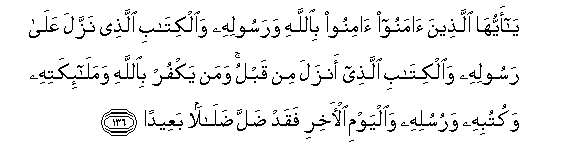
Here is another interesting verse. I just posted a response to a comment on a rather old post, Islam and Tahriif, and this verse came to my mind.
One thing that is particularly important is that in the second part of the verse we have a definition of those who are lost:
...whoever disbelieves in Allah and his angels and his books and his messengers and the last day has gone far astray.
Interesting to notice the plural kutubihi which is formed by the plural of kitaab (book) with the attached pos. pronoun, which here because it follows the preposition "bi" (to believe IN) becomes "kutubihi". Believe in his books. How can Muslims believe in his books if they aren't anywhere to be found, other than the Quran?
Monday, August 04, 2008
Son of top Hamas leader converts to Christianity
Wow, I was just told about this yesterday morning at church by a a visiting (Anglican) priest from England, who is actually Lebanese by ancestry (which is not the same as Arab, mind you).
It is always good to see a little peace and love injected into the perpretual vitriol between Israel and the Palestinians. There is no political situation for that problem, even if two states were formed today (which Israel would not allow, due to water rights, among other things) then rockets would continue to fall from the Palestinian state on a regular basis. There is no political situation. Only the Gospel is powerful enough to break down those barriers and arrogance and self-pity and hate, and yes, they exist on both sides. There is blood on everyone's hands, including your and mine. If the cross means one thing, it is that there is only one victim, in the true meaning of the word: the Lamb of God.
But here is the link to the interview with Hassan Yousef, who said, "I have left a culture that sanctifies terror." Welcome to the Kingdom and to the One, Holy, Catholic, and Apostolic Church, brother Hassan.
Saturday, August 02, 2008
Book Review: Spiritual Warfare in the Middle East
Just finished reading this and found this book review to be adequate:
Spiritual Warfare in the Middle East
by Glenn Patton
Brentwood Christian Press 1992
An interesting little book. However, one would expect the author, a Southern Baptist missionary in Lebanon and Jordan during the 70's, to actually know how to spell "Maronite" since it is, after all, the largest and oldest church in Lebanon--there is no such thing as the 'Marionite' church.
Also grating is his overarching emphasis on being Baptist, as opposed to simply evangelical or even Christian. He has not one positive thing to say about the historical Christian communities of Lebanon and Jordan who managed to stay Christian through centuries of brutal Islamic rule, and one senses that he does not see them any differently than the Shi'a and Sunni Muslim communities in those countries.
In one story though he almost seems apologetic about how his missionary agency (the International Mission Board of the Southern Baptist Conference) is so focused on Baptists only. He is invited to speak to a group of Christians and teach them, he is later told he must cease because they are not formally baptists.
That having been said there are several truly touching moments throughout the book, and it can not be doubted that his years of sacrifice and ministry demonstrate a true and deep Christian longing to see the Gospel (according to the Baptists) increase. The story about the exorcism of a young Jewess is precious, the testimonies about changed lives of both Muslims and nominal Christians are also encouraging. His call for missionaries to the Middle East must be heard.
Finally, the insights into the political and historical situations leading up to the Lebanese Civil War and the attempt of the Palestinians to overthrow the Jordanian monarchy were quite interesting to me, though politics is not his main concern.
In sum, it is a short read and if you happen across it, it will be worth your while to read it, though his treatment of non-Baptist Christians will be annoying to non-Fundamentalists.
[Abu Daoud says: for a better, though different, group of missions testimonies see Ten Muslims Meet Christ by William M. Miller.]
Friday, August 01, 2008
Achmed Kalfa: Martyr, Saint, Convert from Islam
2. Saint Martyr Achmed Kalfa, +1682 (3/16 May).
Achmed, àlso a Turk, lived in Istanbul 150 years before saint Konstantin and, in contrast the latter, he was comfortably off, occupied a significant government post and at moment of converting he was middle-aged.
He had a Russian slave concubine. Achmed magnanimously allowed her to attend Christian Church and he had noticed her particular gracious changes occurring every time her came from the liturgy. Interested in this, he had expressed to the priest his wish to attend the liturgy during the service of Patriarch, and, of course, he had got such an opportunity. As a distinguished guest he had got a special place.
And so during a liturgy this moslem official suddenly had seen that when Patriarch blessed people, his trikiri and fingers irradiated and rays beamed on the heads of all christians, and only its own chapter remained empty. Astonished with such a miracle, Achmed had expressed a desire to be immediately baptized, and this sacrament was secretly perfected on him.
The martyr remains for some time a secret christian. This phenomenon has its justification in Holy Scripture too: 2 Kings 5:17-19, Jn 3. What was happening with hime during this period is not reported. It is possibly that his love to her, who guided his converting to Church, now, in a unity of faith, became immeasurably finest and empyrean. Perphps the saint had for this period several meatings with a spiritual father in Church, where he was baptized, for edification in Law of Christ.
And so he continued until once during a meeting officials did start to argue about better decision.
When queue run up Achmed, and have asked his opinion, he unexpectedly for all aloud has declared:
- A Christian faith is better.
- Are You a christian? - has asked with smile one of the sitting officer.
- Yes, I am a Christian. - slowly, peacefully and audibly has answered the saint and smile climb down on face of asking...
And saint Achmed has endured all and had underwent a martyr's death on May 3 1682.
From HERE.
Subscribe to:
Posts (Atom)