It is well known that the Quran's oldest texts did not contain the diacritical marks which function to show short vowels and stresses. But in fact the situation is even more drastic than that, because it was written in a form of what we might call shorthand, where one symbol could actually represent up to six different letters, thus you could have the word mslm which you could read "muslim" or "musallim" (the one who renders or gives) or, somewhat exotically, "musallam" (the thing that is rendered or given) or even muslam (that which is rendered or yielded), or if we are feeling like going way deep into the recondite grammatical recesses of the Arabic language, "maslam" a place of safety or security. And that is not counting the possibility that the s could also be a sh (though sh l m is not a normal trilateral root in Arabic).
But here is a nice little story to give you an example:
When more and more Muslims of non-Arab origin and also
many ignorant Arabs' studied the Qur'an, faulty pronunciation
and wrong readings began to increase. It is related that at the
time of Du'all (d. 69H/638) someone in Basra read the follow-
ing aya from the Qur'an in a faulty way, which changed the
meaning completely: :
That God and His apostle dissolve obligations with the
pagans' (9: 3).
'That God dissolves obligations with the pagans and the
apostle.'
The mistake occurred through wrongly reading rasulihi
in place of rasuluhu, which could not be distinguished
from the written text, because there were no signs or accents
indicating the correct pronunciation. Unless someone had
memorised the correct version he could out of ignorance
easily commit such a mistake.
Wednesday, August 06, 2008

Tuesday, August 05, 2008
Believe in HIS BOOKS: Al Nisa 4:136
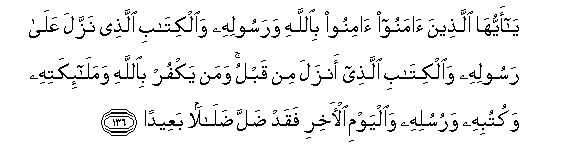
Here is another interesting verse. I just posted a response to a comment on a rather old post, Islam and Tahriif, and this verse came to my mind.
One thing that is particularly important is that in the second part of the verse we have a definition of those who are lost:
...whoever disbelieves in Allah and his angels and his books and his messengers and the last day has gone far astray.
Interesting to notice the plural kutubihi which is formed by the plural of kitaab (book) with the attached pos. pronoun, which here because it follows the preposition "bi" (to believe IN) becomes "kutubihi". Believe in his books. How can Muslims believe in his books if they aren't anywhere to be found, other than the Quran?
Monday, August 04, 2008
Son of top Hamas leader converts to Christianity
Wow, I was just told about this yesterday morning at church by a a visiting (Anglican) priest from England, who is actually Lebanese by ancestry (which is not the same as Arab, mind you).
It is always good to see a little peace and love injected into the perpretual vitriol between Israel and the Palestinians. There is no political situation for that problem, even if two states were formed today (which Israel would not allow, due to water rights, among other things) then rockets would continue to fall from the Palestinian state on a regular basis. There is no political situation. Only the Gospel is powerful enough to break down those barriers and arrogance and self-pity and hate, and yes, they exist on both sides. There is blood on everyone's hands, including your and mine. If the cross means one thing, it is that there is only one victim, in the true meaning of the word: the Lamb of God.
But here is the link to the interview with Hassan Yousef, who said, "I have left a culture that sanctifies terror." Welcome to the Kingdom and to the One, Holy, Catholic, and Apostolic Church, brother Hassan.
It is always good to see a little peace and love injected into the perpretual vitriol between Israel and the Palestinians. There is no political situation for that problem, even if two states were formed today (which Israel would not allow, due to water rights, among other things) then rockets would continue to fall from the Palestinian state on a regular basis. There is no political situation. Only the Gospel is powerful enough to break down those barriers and arrogance and self-pity and hate, and yes, they exist on both sides. There is blood on everyone's hands, including your and mine. If the cross means one thing, it is that there is only one victim, in the true meaning of the word: the Lamb of God.
But here is the link to the interview with Hassan Yousef, who said, "I have left a culture that sanctifies terror." Welcome to the Kingdom and to the One, Holy, Catholic, and Apostolic Church, brother Hassan.
Saturday, August 02, 2008
Book Review: Spiritual Warfare in the Middle East
Just finished reading this and found this book review to be adequate:
Spiritual Warfare in the Middle East
by Glenn Patton
Brentwood Christian Press 1992
An interesting little book. However, one would expect the author, a Southern Baptist missionary in Lebanon and Jordan during the 70's, to actually know how to spell "Maronite" since it is, after all, the largest and oldest church in Lebanon--there is no such thing as the 'Marionite' church.
Also grating is his overarching emphasis on being Baptist, as opposed to simply evangelical or even Christian. He has not one positive thing to say about the historical Christian communities of Lebanon and Jordan who managed to stay Christian through centuries of brutal Islamic rule, and one senses that he does not see them any differently than the Shi'a and Sunni Muslim communities in those countries.
In one story though he almost seems apologetic about how his missionary agency (the International Mission Board of the Southern Baptist Conference) is so focused on Baptists only. He is invited to speak to a group of Christians and teach them, he is later told he must cease because they are not formally baptists.
That having been said there are several truly touching moments throughout the book, and it can not be doubted that his years of sacrifice and ministry demonstrate a true and deep Christian longing to see the Gospel (according to the Baptists) increase. The story about the exorcism of a young Jewess is precious, the testimonies about changed lives of both Muslims and nominal Christians are also encouraging. His call for missionaries to the Middle East must be heard.
Finally, the insights into the political and historical situations leading up to the Lebanese Civil War and the attempt of the Palestinians to overthrow the Jordanian monarchy were quite interesting to me, though politics is not his main concern.
In sum, it is a short read and if you happen across it, it will be worth your while to read it, though his treatment of non-Baptist Christians will be annoying to non-Fundamentalists.
[Abu Daoud says: for a better, though different, group of missions testimonies see Ten Muslims Meet Christ by William M. Miller.]
Spiritual Warfare in the Middle East
by Glenn Patton
Brentwood Christian Press 1992
An interesting little book. However, one would expect the author, a Southern Baptist missionary in Lebanon and Jordan during the 70's, to actually know how to spell "Maronite" since it is, after all, the largest and oldest church in Lebanon--there is no such thing as the 'Marionite' church.
Also grating is his overarching emphasis on being Baptist, as opposed to simply evangelical or even Christian. He has not one positive thing to say about the historical Christian communities of Lebanon and Jordan who managed to stay Christian through centuries of brutal Islamic rule, and one senses that he does not see them any differently than the Shi'a and Sunni Muslim communities in those countries.
In one story though he almost seems apologetic about how his missionary agency (the International Mission Board of the Southern Baptist Conference) is so focused on Baptists only. He is invited to speak to a group of Christians and teach them, he is later told he must cease because they are not formally baptists.
That having been said there are several truly touching moments throughout the book, and it can not be doubted that his years of sacrifice and ministry demonstrate a true and deep Christian longing to see the Gospel (according to the Baptists) increase. The story about the exorcism of a young Jewess is precious, the testimonies about changed lives of both Muslims and nominal Christians are also encouraging. His call for missionaries to the Middle East must be heard.
Finally, the insights into the political and historical situations leading up to the Lebanese Civil War and the attempt of the Palestinians to overthrow the Jordanian monarchy were quite interesting to me, though politics is not his main concern.
In sum, it is a short read and if you happen across it, it will be worth your while to read it, though his treatment of non-Baptist Christians will be annoying to non-Fundamentalists.
[Abu Daoud says: for a better, though different, group of missions testimonies see Ten Muslims Meet Christ by William M. Miller.]
Friday, August 01, 2008
Achmed Kalfa: Martyr, Saint, Convert from Islam
2. Saint Martyr Achmed Kalfa, +1682 (3/16 May).
Achmed, àlso a Turk, lived in Istanbul 150 years before saint Konstantin and, in contrast the latter, he was comfortably off, occupied a significant government post and at moment of converting he was middle-aged.
He had a Russian slave concubine. Achmed magnanimously allowed her to attend Christian Church and he had noticed her particular gracious changes occurring every time her came from the liturgy. Interested in this, he had expressed to the priest his wish to attend the liturgy during the service of Patriarch, and, of course, he had got such an opportunity. As a distinguished guest he had got a special place.
And so during a liturgy this moslem official suddenly had seen that when Patriarch blessed people, his trikiri and fingers irradiated and rays beamed on the heads of all christians, and only its own chapter remained empty. Astonished with such a miracle, Achmed had expressed a desire to be immediately baptized, and this sacrament was secretly perfected on him.
The martyr remains for some time a secret christian. This phenomenon has its justification in Holy Scripture too: 2 Kings 5:17-19, Jn 3. What was happening with hime during this period is not reported. It is possibly that his love to her, who guided his converting to Church, now, in a unity of faith, became immeasurably finest and empyrean. Perphps the saint had for this period several meatings with a spiritual father in Church, where he was baptized, for edification in Law of Christ.
And so he continued until once during a meeting officials did start to argue about better decision.
When queue run up Achmed, and have asked his opinion, he unexpectedly for all aloud has declared:
- A Christian faith is better.
- Are You a christian? - has asked with smile one of the sitting officer.
- Yes, I am a Christian. - slowly, peacefully and audibly has answered the saint and smile climb down on face of asking...
And saint Achmed has endured all and had underwent a martyr's death on May 3 1682.
From HERE.
Achmed, àlso a Turk, lived in Istanbul 150 years before saint Konstantin and, in contrast the latter, he was comfortably off, occupied a significant government post and at moment of converting he was middle-aged.
He had a Russian slave concubine. Achmed magnanimously allowed her to attend Christian Church and he had noticed her particular gracious changes occurring every time her came from the liturgy. Interested in this, he had expressed to the priest his wish to attend the liturgy during the service of Patriarch, and, of course, he had got such an opportunity. As a distinguished guest he had got a special place.
And so during a liturgy this moslem official suddenly had seen that when Patriarch blessed people, his trikiri and fingers irradiated and rays beamed on the heads of all christians, and only its own chapter remained empty. Astonished with such a miracle, Achmed had expressed a desire to be immediately baptized, and this sacrament was secretly perfected on him.
The martyr remains for some time a secret christian. This phenomenon has its justification in Holy Scripture too: 2 Kings 5:17-19, Jn 3. What was happening with hime during this period is not reported. It is possibly that his love to her, who guided his converting to Church, now, in a unity of faith, became immeasurably finest and empyrean. Perphps the saint had for this period several meatings with a spiritual father in Church, where he was baptized, for edification in Law of Christ.
And so he continued until once during a meeting officials did start to argue about better decision.
When queue run up Achmed, and have asked his opinion, he unexpectedly for all aloud has declared:
- A Christian faith is better.
- Are You a christian? - has asked with smile one of the sitting officer.
- Yes, I am a Christian. - slowly, peacefully and audibly has answered the saint and smile climb down on face of asking...
And saint Achmed has endured all and had underwent a martyr's death on May 3 1682.
From HERE.
Thursday, July 31, 2008
Obama, the Messiah
Sometimes American politics is just ridiculous, but when you get others involved (Europeans) it just gets even more fun :-)
Wednesday, July 30, 2008
Williams on the Trinity; religious dialogue with Islam
Rowan Williams responded to the Common Word letter from several dozen Muslim scholars, and there is a very nice section in his response about the Trinity, which follows:
Because God exists in this threefold pattern of interdependent action, the relationship between Father, Son and Holy Spirit is one in which there is always a ‘giving place’ to each other, each standing back so that the other may act. The only human language we have for this is love: the three dimensions of divine life relate to each other in self-sacrifice or self-giving. The doctrine of the Trinity is a way of explaining why we say that God is love, not only that he shows love.
That having been said, need I mention that inter-religious dialogue only happens in places where Muslims are a minority? Islam, in the end I suspect, has no use for such dialogue.
I have written about this topic in Islam and the Other Religions.
Because God exists in this threefold pattern of interdependent action, the relationship between Father, Son and Holy Spirit is one in which there is always a ‘giving place’ to each other, each standing back so that the other may act. The only human language we have for this is love: the three dimensions of divine life relate to each other in self-sacrifice or self-giving. The doctrine of the Trinity is a way of explaining why we say that God is love, not only that he shows love.
That having been said, need I mention that inter-religious dialogue only happens in places where Muslims are a minority? Islam, in the end I suspect, has no use for such dialogue.
I have written about this topic in Islam and the Other Religions.
Tuesday, July 29, 2008
Anglicans trying to pull their stuff together
Looks like the Anglican bishops at Lambeth in Kent are actually about to employ some form or discipline! Discipline! What? How un-Anglican. Yet it is of the essence of the church, the power to loose and to bind, to forgive and retain sins, and to bring the sinning brother "before the whole ekklesia." But will it work? I'm not incredibly positive, but it seems like the Americans and Canadians are finally realizing that a) they have really pissed off everyone, and b) that while they have money and lots of bishops, they represent a very small section of the Anglican Communion.
You can read HERE for more on the specific plan.
LAMBETH: Windsor Group Announces Forum to Deal with Rebels
The Windsor Continuation Group today announced that it has proposed an Anglican Communion Pastoral Forum "to act in the Anglican Communion in a rapid manner to emerging threats to its life." The first problem facing the Forum would be the role of homosexuality in the church, and second would be the problem of Anglicans opposed to homosexual ordinations and blessings and thirdly those who have crossed provincial borders to find fellowship.
At a press conference to release a new Windsor Group paper on the next steps for the Windsor Process, Bishop Clive Handford, the Group chairman, said that the members of the proposed Forum ought to recognize the "breadth of the communion," and they are to be appointed by the Archbishop of Canterbury. "This could well be a body ... that could respond quickly where there's a pressure point in the communion," said Handford.
You can read HERE for more on the specific plan.
LAMBETH: Windsor Group Announces Forum to Deal with Rebels
The Windsor Continuation Group today announced that it has proposed an Anglican Communion Pastoral Forum "to act in the Anglican Communion in a rapid manner to emerging threats to its life." The first problem facing the Forum would be the role of homosexuality in the church, and second would be the problem of Anglicans opposed to homosexual ordinations and blessings and thirdly those who have crossed provincial borders to find fellowship.
At a press conference to release a new Windsor Group paper on the next steps for the Windsor Process, Bishop Clive Handford, the Group chairman, said that the members of the proposed Forum ought to recognize the "breadth of the communion," and they are to be appointed by the Archbishop of Canterbury. "This could well be a body ... that could respond quickly where there's a pressure point in the communion," said Handford.
Friday, July 25, 2008

Thursday, July 24, 2008
The stuff I've writtenكل ما كتب ابو داود
Every now and then one of my eight readers asks if I have a place that has all my own writings together in one place. Rather than sending them all over the place, I have started the blog Abu Daoud which only has the relatively few articles I have written myself. You can check it out at:
AbuDaoud.blogspot.com
Abu Daoud
If you only want to read the stuff I write, then use that one for your RSS feed or Reader.google account. If you read THIS blog regularly, then just ignore the other one.
AbuDaoud.blogspot.com
Abu Daoud
If you only want to read the stuff I write, then use that one for your RSS feed or Reader.google account. If you read THIS blog regularly, then just ignore the other one.
Wednesday, July 23, 2008
Americans and Delayed Gratification (AKA discipline)
Well, this blog is happy to point to deficiencies in every culture, because the Kingdom of God is not any one culture, nor is it something apart from culture, but it is something divine that seeks to redeem and transform culture. That having been said here is some interesting stuff about Americans and their loss to delay gratification:
The remarkable thing about the study is that a student's ability at age four to defer gratification is correlated with better outcomes much later in life, such as academic and social competence. For example, one follow-up paper found a statistically significant relationship between how long a student waited to ring the bell and -- more than a decade later -- their "ability to cope with frustration and stress in adolescence."
New York Times columnist David Brooks has cited this study and inferred that most social problems are rooted in an inability to defer gratification. He argues that for people with poor self-control "life is a parade of foolish decisions: teen pregnancy, drugs, gambling, truancy and crime." I agree. I can find no other compelling explanation for why someone would do something as utterly ridiculous as dropping out of high school, no matter how bad the school is.
But I'll see David Brooks and raise him one. I find myself asking an even bigger question: Is America as a nation losing its ability to wait for the second marshmallow? By that, I mean can we still muster the political will and personal sacrifice to make investments today that will make us richer and stronger 10, 20, or 50 years from now?
From HERE.
The remarkable thing about the study is that a student's ability at age four to defer gratification is correlated with better outcomes much later in life, such as academic and social competence. For example, one follow-up paper found a statistically significant relationship between how long a student waited to ring the bell and -- more than a decade later -- their "ability to cope with frustration and stress in adolescence."
New York Times columnist David Brooks has cited this study and inferred that most social problems are rooted in an inability to defer gratification. He argues that for people with poor self-control "life is a parade of foolish decisions: teen pregnancy, drugs, gambling, truancy and crime." I agree. I can find no other compelling explanation for why someone would do something as utterly ridiculous as dropping out of high school, no matter how bad the school is.
But I'll see David Brooks and raise him one. I find myself asking an even bigger question: Is America as a nation losing its ability to wait for the second marshmallow? By that, I mean can we still muster the political will and personal sacrifice to make investments today that will make us richer and stronger 10, 20, or 50 years from now?
From HERE.
Tuesday, July 22, 2008
Good-looking bishop; Christianity and grace and beauty

I saw this picture over at Canterbury Tales and just thought it was great. The vestments are really beautiful. And that is something that has to do with Christianity and Islam. If Christianity is truer then it has to be more beautiful. Also, kudos to Benedict for staying in good shape.
Christianity without beauty is like Christianity without grace.
Sunday, July 20, 2008
Islam, Deism, and Despotism
The New Jerusalem
GK Chesterton
Ch. XII: The Fall of Chivalry
It was exactly because it seemed self-evident, to Moslems as
to Bolshevists, that their simple creed was suited to everybody,
that they wished in that particular sweeping fashion to impose it
on everybody. It was because Islam was broad that Moslems were narrow.
And because it was not a hard religion it was a heavy rule.
Because it was without a self-correcting complexity, it allowed
of those simple and masculine but mostly rather dangerous
appetites that show themselves in a chieftain or a lord.
As it had the simplest sort of religion, monotheism, so it had
the simplest sort of government, monarchy. There was exactly
the same direct spirit in its despotism as in its deism.
GK Chesterton
Ch. XII: The Fall of Chivalry
It was exactly because it seemed self-evident, to Moslems as
to Bolshevists, that their simple creed was suited to everybody,
that they wished in that particular sweeping fashion to impose it
on everybody. It was because Islam was broad that Moslems were narrow.
And because it was not a hard religion it was a heavy rule.
Because it was without a self-correcting complexity, it allowed
of those simple and masculine but mostly rather dangerous
appetites that show themselves in a chieftain or a lord.
As it had the simplest sort of religion, monotheism, so it had
the simplest sort of government, monarchy. There was exactly
the same direct spirit in its despotism as in its deism.
Subscribe to:
Posts (Atom)