I often say to people when they say 'Christians should be reading the Bible', 'well, Christians should be reading the newspaper.'HT to VirtueOnline for this tidbit.
Showing posts with label Africa. Show all posts
Showing posts with label Africa. Show all posts
Friday, September 18, 2015
Bp John Harrower on context and Bible
I really liked this quote from the outgoing Anglican Bishop of Tasmania:

Wednesday, February 05, 2014
Algerian Christian refused burial in public cemetery
A Christian family in Algeria has been refused permission to bury their son in the local public cemetery because he was not a Muslim.
“The leaders of the mosque demanded that I would have to follow Islamic burial rites if I was to bury my son in the cemetery,” said the father of 24-year-old Lahlou Naraoui, a University student.
Naraoui’s family, who live in Chemini in the Kabylie region of northern Algeria, said they could not follow the Muslim leaders’ demands and instead chose to bury their son on private land.From World Watch Monitor.
But really, in the end this is good. It means that Christians must form their own identity, including places of burial. And in terms of North Africa, this is most fitting, as the first Christians there achieved legal recognition as burial societies, and some of their first real estate was in grave yards.
In the end is my beginning, as TS Eliot said. Indeed.
Monday, August 12, 2013
Conversion from Christianity to Islam in Cameroon
In this part of the continent, including Cameroon, there has been growing influence of Islam through economic development. The country is a member of the Organization of Islamic Cooperation (OIC) and nations like Morocco, Tunisia and Turkey are increasingly investing in Cameroon. Other investors include Arab Contractors based in Cairo and the Islamic development bank in Jeddah, a coastal city in Saudi Arabia. These investments often come with increased Islamic influence and pressure on usually lower- income rural people to embrace Islam for the economic benefits connected with such a move.Read it all, at Open Doors.
Friday, July 08, 2011
Augustine: "To Thee [O God] there is no such thing as evil..."
Augustine on evil as lack of being:
To thee there is no such thing as evil, and even in thy whole creation taken as a whole, there is not; because there is nothing from beyond it that can burst in and destroy the order which thou hast appointed for it. But in the parts of creation, some things, because they do not harmonize with others, are considered evil. Yet those same things harmonize with others and are good, and in themselves are good. And all these things which do not harmonize with each other still harmonize with the inferior part of creation which we call the earth, having its own cloudy and windy sky of like nature with itself.
Confessions 7:13
What a fount of comfort and wisdom is this great African saint.
To thee there is no such thing as evil, and even in thy whole creation taken as a whole, there is not; because there is nothing from beyond it that can burst in and destroy the order which thou hast appointed for it. But in the parts of creation, some things, because they do not harmonize with others, are considered evil. Yet those same things harmonize with others and are good, and in themselves are good. And all these things which do not harmonize with each other still harmonize with the inferior part of creation which we call the earth, having its own cloudy and windy sky of like nature with itself.
Confessions 7:13
What a fount of comfort and wisdom is this great African saint.
Monday, February 21, 2011
Feb 21, 2011: More reflections on the Middle East
The developments in Egypt, and now Libya are really unprecedented. There was no way for anyone to expect this.
Well, let me qualify that. It has been known for some time that there was a demographic time bomb in many of these countries. You have several factors combining to create instability and revolution: a large population of young males who are largely a) unemployed, and b) unmarried. This always leads to instability, and now we have seen that boil to the surface, though, like I said, no one saw it coming right now and in this form.
In some ways, the self-immolation of the young Tunisian fruit-vender is what occasioned this whole series of revolutions. It is one of those small, obscure acts that parlayed itself into something much larger, like the assassination of a certain arch-duke.
But the real question is what does the future hold? A couple of points follow.
1) The Western press often stresses that the movements in Egypt and Tunisia had a lot of 'modern' or 'secular' people in them. To which I respond, who cares? What matters is coordination and organization. The Muslim Brotherhood has that. In Egypt, no one else does.
2) Islam and democracy are in esse incompatible. Islam is devoted to the imitation of the Prophet, who was totalitarian in his polity without any question. He consolidated all political, military, juridical, and religious authority into his own hands. Democracy, on the other hand, is based on a Judeo-Christian anthropology, and it seeks to spread power as widely as possible because it understands that humans in their sinfulness cannot be trusted with the totality of power.
3) Turkey. Everyone points to Turkey and says, see Islam and democracy can work! Sorry, but that is not quite right. The inspiration for Turkey's democracy was nationalism, not Islam. In fact, as Turkey has grown more Islamic in its polity, it is questionable to what extent democracy there can survive. Also, Turkey has undergone reforms in order to enter the EU. Tunisia and Egypt and Libya don't have that carrot dangling in front of them.
4) The foundational problems are not with regimes, but demographics, agriculture, and Islam. Too many children (especially in Egypt), too little arable land, and an Islamic society which, for whatever reason, is often tribalistic and nepotistic. A new regime, even a secular, democratic one, will not solve these problems.
5) Freedom. Ultimately, if people want freedom, they will have to find some other religion. Pure and simple. Not very PC. But there you have it.
So what does this all lead to? A struggle between nationalist kleptocratic militaries and Islamists. Not very much fun.
But let us pray. As Martin Luther said, 'Even the devil is God's devil.'
Abu Daoud
Well, let me qualify that. It has been known for some time that there was a demographic time bomb in many of these countries. You have several factors combining to create instability and revolution: a large population of young males who are largely a) unemployed, and b) unmarried. This always leads to instability, and now we have seen that boil to the surface, though, like I said, no one saw it coming right now and in this form.
In some ways, the self-immolation of the young Tunisian fruit-vender is what occasioned this whole series of revolutions. It is one of those small, obscure acts that parlayed itself into something much larger, like the assassination of a certain arch-duke.
But the real question is what does the future hold? A couple of points follow.
1) The Western press often stresses that the movements in Egypt and Tunisia had a lot of 'modern' or 'secular' people in them. To which I respond, who cares? What matters is coordination and organization. The Muslim Brotherhood has that. In Egypt, no one else does.
2) Islam and democracy are in esse incompatible. Islam is devoted to the imitation of the Prophet, who was totalitarian in his polity without any question. He consolidated all political, military, juridical, and religious authority into his own hands. Democracy, on the other hand, is based on a Judeo-Christian anthropology, and it seeks to spread power as widely as possible because it understands that humans in their sinfulness cannot be trusted with the totality of power.
3) Turkey. Everyone points to Turkey and says, see Islam and democracy can work! Sorry, but that is not quite right. The inspiration for Turkey's democracy was nationalism, not Islam. In fact, as Turkey has grown more Islamic in its polity, it is questionable to what extent democracy there can survive. Also, Turkey has undergone reforms in order to enter the EU. Tunisia and Egypt and Libya don't have that carrot dangling in front of them.
4) The foundational problems are not with regimes, but demographics, agriculture, and Islam. Too many children (especially in Egypt), too little arable land, and an Islamic society which, for whatever reason, is often tribalistic and nepotistic. A new regime, even a secular, democratic one, will not solve these problems.
5) Freedom. Ultimately, if people want freedom, they will have to find some other religion. Pure and simple. Not very PC. But there you have it.
So what does this all lead to? A struggle between nationalist kleptocratic militaries and Islamists. Not very much fun.
But let us pray. As Martin Luther said, 'Even the devil is God's devil.'
Abu Daoud
Tuesday, April 20, 2010
Abp. Gabriel of Khartoum on Changing the World
The Christians, any environment they live in today, need to be of that type, I.e. Christians who have those principles in themselves, who proclaim them and live according to them, and are ready to suffer for these principles. It is that way of living which will change the world and our country. It will not be changed by powerful people; it will be changed by simple people who have determination, courage and power from Jesus Christ who himself was poor and a victim of human cruelty, but who has finally overcame evil by his passion, death and resurrection.
Gabriel Cardinal Zubeir Wako,
Archbishop of Khartoum
Khartoum, Easter 2010
Gabriel Cardinal Zubeir Wako,
Archbishop of Khartoum
Khartoum, Easter 2010
Sunday, April 11, 2010
Anglican Nigerians reaching out to Muslims
A Nigerian Anglican archbishop told 825 mostly Anglicans and Episcopalians that included 20 bishops and three archbishops that the outbreaks of violence in Northern Nigeria is a result of tens of thousands of Islamists becoming Christians resulting in the formation of 49 new dioceses.
The Rt. Rev. Edmund Akanya, Archbishop of Kaduna and Bishop of Kebbi from the Anglican Province of Nigeria told conferees at the New Wineskins conference for Global Missions that outreach to Muslims in Nigeria with the gospel is "second nature" to Nigerian Anglicans and that Anglicans "face this challenge every day."
"After experiencing Jesus Christ as Lord and Savior I went into mission. Up to 20 years ago we were dependent on missionaries. Now we have a thriving church with our own missionaries reaching out to Muslims, animists and pagans," he told the missions-minded audience many of whom had come from half way around the globe to plan mission strategies to reach the world for Jesus Christ.
From HERE.
The Rt. Rev. Edmund Akanya, Archbishop of Kaduna and Bishop of Kebbi from the Anglican Province of Nigeria told conferees at the New Wineskins conference for Global Missions that outreach to Muslims in Nigeria with the gospel is "second nature" to Nigerian Anglicans and that Anglicans "face this challenge every day."
"After experiencing Jesus Christ as Lord and Savior I went into mission. Up to 20 years ago we were dependent on missionaries. Now we have a thriving church with our own missionaries reaching out to Muslims, animists and pagans," he told the missions-minded audience many of whom had come from half way around the globe to plan mission strategies to reach the world for Jesus Christ.
From HERE.
Wednesday, February 24, 2010
Lavigerie on Politics
"... Never take sides in any political question, whatever it may be; support no cause other than that of the faith and humanity, be respectful towards authority wherever it is established; give to all alike the co-operation of your charity; never allow your cause or your name to become involved in purely human interests; if you are wrongfully accused of doing so, protest and go on protesting, do not let people disregard the fact that you are truly apostolic men, that is to say men who know how to embrace with a like affection all the nations of the world. Give proof of this, show not so much by words as by deeds that this is your one and only desire."
--Charles Lavigerie, founder of the White Fathers
--Charles Lavigerie, founder of the White Fathers
Tuesday, October 13, 2009
Friday, May 29, 2009
Raising Support: "All things come of thee O Lord..."
"All things come of thee O Lord, and of thine own we have given thee."
I have never, and God willing will never, use this blog to raise support for our mission here in the Middle East. That is not why I started it and TBTG we are well and have food and shelter and all that we need.
BUT, if you want to support a family raising support for going on mission to Dar al Islam then I have a few options for you and your church! Concerned about N Africa? Let me know. Wanting to support some folks who desire to work in Europe in a heavily-Islamized area? Let me know. These two families have been out on the road raising support for a while, they are both ALMOST there, but not quite. Your pledge of $50/month or $100/month would go a long way.
Do I sound bold? I do. But have I not earned the right to be bold? And I do not exercise this authority on my own behalf, but on behalf of my brothers who have heard the call to be a Christian witness in the Muslim world.
Look, it's simple: if you don't send, they can't go. If they don't go, they can't preach. And if they there is no preaching, then how will they hear? Sound familiar? I thought so, but it was valid in Paul's day and it is in ours.
Salamu Aleykum!
سلام عليكم
ابو داود
winterlightning [a+] safe-mail [d0t] net
I have never, and God willing will never, use this blog to raise support for our mission here in the Middle East. That is not why I started it and TBTG we are well and have food and shelter and all that we need.
BUT, if you want to support a family raising support for going on mission to Dar al Islam then I have a few options for you and your church! Concerned about N Africa? Let me know. Wanting to support some folks who desire to work in Europe in a heavily-Islamized area? Let me know. These two families have been out on the road raising support for a while, they are both ALMOST there, but not quite. Your pledge of $50/month or $100/month would go a long way.
Do I sound bold? I do. But have I not earned the right to be bold? And I do not exercise this authority on my own behalf, but on behalf of my brothers who have heard the call to be a Christian witness in the Muslim world.
Look, it's simple: if you don't send, they can't go. If they don't go, they can't preach. And if they there is no preaching, then how will they hear? Sound familiar? I thought so, but it was valid in Paul's day and it is in ours.
Salamu Aleykum!
سلام عليكم
ابو داود
winterlightning [a+] safe-mail [d0t] net
Tuesday, March 10, 2009
Monday, November 03, 2008
13-yeard old rape victim sentenced to death under Islamic Shari'a
Note that this took place in a STADIUM:
MOGADISHU, Somalia (AP) -- A 13-year-old girl who said she had been raped was stoned to death in Somalia after being accused of adultery by Islamic militants, a human rights group said.
Dozens of men stoned Aisha Ibrahim Duhulow to death Oct. 27 in a stadium packed with 1,000 spectators in the southern port city of Kismayo, Amnesty International and Somali media reported, citing witnesses. The Islamic militia in charge of Kismayo had accused her of adultery after she reported that three men had raped her, the rights group said.
Initial local media reports said Duhulow was 23, but her father told Amnesty International she was 13. [...]
From CNN.
Somalia is both the most Islamic nation in the world (measured by % of population) and the most lawless nation in the world.
MOGADISHU, Somalia (AP) -- A 13-year-old girl who said she had been raped was stoned to death in Somalia after being accused of adultery by Islamic militants, a human rights group said.
Dozens of men stoned Aisha Ibrahim Duhulow to death Oct. 27 in a stadium packed with 1,000 spectators in the southern port city of Kismayo, Amnesty International and Somali media reported, citing witnesses. The Islamic militia in charge of Kismayo had accused her of adultery after she reported that three men had raped her, the rights group said.
Initial local media reports said Duhulow was 23, but her father told Amnesty International she was 13. [...]
From CNN.
Somalia is both the most Islamic nation in the world (measured by % of population) and the most lawless nation in the world.
Saturday, November 01, 2008
Islam in Sub-Saharan Africa and Slavery
In his polemic against Islam, Richardson advances an interesting theory. He wonders why sub-Saharan Africa was not Islamized given that N. Africa and the Horn of Africa had been Islamized for many centuries by the time that the Christian missions and later the AIC's started winning millions upon millions of converts in the 19th and 20th Centuries.
His answer is that the Muslims were all slavers, given that the Quran clearly endorses slavery (and in fact has an entire chapter called The Slaves) and that the Prophet himself owned slaves, they only were able to Islamize the black Africans with whom they worked to enslave other Africans.
Had mullahs opposed slavery instead of condoning it, they could have ranged freely from Timbuktu almost to Cape Town, opening mosques and establishing Islamic school in the region. In short, they could have Islamized all of Africa, not just a fringe above and below the Sahara and on the coast of Zanzibar. (Richardson 203)
Secrets of the Koran by Don Richardson.
His answer is that the Muslims were all slavers, given that the Quran clearly endorses slavery (and in fact has an entire chapter called The Slaves) and that the Prophet himself owned slaves, they only were able to Islamize the black Africans with whom they worked to enslave other Africans.
Had mullahs opposed slavery instead of condoning it, they could have ranged freely from Timbuktu almost to Cape Town, opening mosques and establishing Islamic school in the region. In short, they could have Islamized all of Africa, not just a fringe above and below the Sahara and on the coast of Zanzibar. (Richardson 203)
Secrets of the Koran by Don Richardson.
Monday, September 22, 2008
Early church in the cemetery
As has been pointed out by many writers--notably Sir William Ramsay--the early Christians earned their recognition as a legally constituted body in the eyes of the state by enrolling themselves as members of a Burial Club : their cemeteries were recognized as the lawful property of the community, and they themselves were allowed to assemble at the spot where their dead lay buried ; and so for North Africa at least the cemeteries -- areae -- became the first churches, and the tombs of martyrs the first altars: though it must be remembered that there was neither church nor altar proper, till a much later date. We find therefore that the first cry of the populace in time of persecution was "away with the cemeteries !"
The Church in North Africa AD 200, p. 15, 16
Stuart Donaldson, 1902
Cambridge U Press
So next time you talk to someone who wants to go back to the pure, early church you can take them to the graveyard.
The Church in North Africa AD 200, p. 15, 16
Stuart Donaldson, 1902
Cambridge U Press
So next time you talk to someone who wants to go back to the pure, early church you can take them to the graveyard.
Tuesday, June 17, 2008
News from the Anglican Diocese in Egypt
Good to be back home in the Middle East! I will say the consultation I attended was very helpful and while I have some reservations I am looking forward to putting the stuff into practice.
That having been said I do have some more travel coming up, to GAFCON. If you will be there then you know what it is, if you don't know what it is then it's probably not important to you. If anyone will be there and would like to meet for kebab or something like e-mail me at winterlightning [a+] safe-mail [do+] net.
Meanwhile, here is some recent news from the Episcopal Diocese of Egypt, North Africa, and the Horn of Africa. Congrats to soon-to-be-bishop Bill, whom I have never met personally:
The following announcement was made by the office of the President Bishop and Bishop of Egypt [Mouneer Anis]:
It is with great joy that we announce the formation of a new Episcopal Area in North Africa. We have decided to appoint the Rev. Canon Dr. Bill Musk as Area Bishop for North Africa as well as Rector of St. George’s, Tunis.
With the growth of the Church in this area and increasing demands for discipleship, community service and interfaith dialogue, we felt that the time has come to create this new Episcopal Area. We are sure that Canon Bill Musk has a lot to contribute to the churches in this area.
Rev. Dr. Bill Musk, 59 years, and his wife Hilary have lived in this region for over a decade and served here in All Saints' Cathedral from 1981 to 1986. He is a well-known Islamicist and the author of several books: The Unseen Face of Islam, Touching the Soul of Islam, Holy War, Kissing Cousins? and The Certainty Trap.
He is currently the vicar of Holy Trinity & St Matthias, Tulse Hill, London. He has four daughters and three grandchildren.
We warmly welcome Bill and Hilary back to our diocesan family. Your prayer support for them and the churches in North Africa would be much appreciated.
That having been said I do have some more travel coming up, to GAFCON. If you will be there then you know what it is, if you don't know what it is then it's probably not important to you. If anyone will be there and would like to meet for kebab or something like e-mail me at winterlightning [a+] safe-mail [do+] net.
Meanwhile, here is some recent news from the Episcopal Diocese of Egypt, North Africa, and the Horn of Africa. Congrats to soon-to-be-bishop Bill, whom I have never met personally:
The following announcement was made by the office of the President Bishop and Bishop of Egypt [Mouneer Anis]:
It is with great joy that we announce the formation of a new Episcopal Area in North Africa. We have decided to appoint the Rev. Canon Dr. Bill Musk as Area Bishop for North Africa as well as Rector of St. George’s, Tunis.
With the growth of the Church in this area and increasing demands for discipleship, community service and interfaith dialogue, we felt that the time has come to create this new Episcopal Area. We are sure that Canon Bill Musk has a lot to contribute to the churches in this area.
Rev. Dr. Bill Musk, 59 years, and his wife Hilary have lived in this region for over a decade and served here in All Saints' Cathedral from 1981 to 1986. He is a well-known Islamicist and the author of several books: The Unseen Face of Islam, Touching the Soul of Islam, Holy War, Kissing Cousins? and The Certainty Trap.
He is currently the vicar of Holy Trinity & St Matthias, Tulse Hill, London. He has four daughters and three grandchildren.
We warmly welcome Bill and Hilary back to our diocesan family. Your prayer support for them and the churches in North Africa would be much appreciated.
Saturday, April 12, 2008
EN 41: indestructible witness and martyrdom
§40 is the beginning of Section IV, and sets up the question: how to evangelize? Paul makes some comments about how it is especially the role of the bishop to decide how to evangelize, which is ironic because the evangelism I have seen in the Catholic church usually happens despite the hierarchy, not because of it. Of course my experience is quite limited and I'm guessing there are bishops out there who wake up and ask, how can I seek the conversion of the people in this city?
But the central question has turned to one of method, after discussing the definition of evangelism, and then its relation to liberation and politics and human rights.
§41 stipulates that "the first means of evangelization is the witness of an authentically Christian life, given over to God in a communion that nothing should destroy and at the same time given to one's neighbor with limitless zeal." Again we note the personal-communal balance which Paul has so carefully preserved, quite explicitly, several times. And when I hear 'that nothing should destroy,' from over here in Dar al Islam, I think of martyrdom and physical persecution right away. It is simply a fact of life here for the Christian who is an active witness to non-Christians.
And then here we have a very quotable line:
"Modern man listens more willingly to witnesses than to teachers, and if he does listen to teachers, it is because they are witnesses."
Which seems prescient to me. He was writing in 1975 which one could say was during the shift or mutation from Modernism to post-modernism, and thus the primacy of personal experience over didactic teaching. Let us also recall that in Greek the words 'martyr' and 'witness' are the same.
But I must say that I have found a certain romanticism about persecution among Christians in the West. Everyone likes to quote Tertullian: the blood of the martyrs is the seed of the church. In general it is true that there is a spiritual dynamic to the Kingdom of God which subverts or deconstructs the patterns of ordering of our age--"nostra aetate". But when one considers the desert of North Africa which was once home to a vibrant Christian community, or Asia Minor which is now the spiritual wasteland of Turkey, one must amend Tertullian (himself from North Africa):
The blood of the martyrs is the seed of the church, except when Islam is involved.
But the central question has turned to one of method, after discussing the definition of evangelism, and then its relation to liberation and politics and human rights.
§41 stipulates that "the first means of evangelization is the witness of an authentically Christian life, given over to God in a communion that nothing should destroy and at the same time given to one's neighbor with limitless zeal." Again we note the personal-communal balance which Paul has so carefully preserved, quite explicitly, several times. And when I hear 'that nothing should destroy,' from over here in Dar al Islam, I think of martyrdom and physical persecution right away. It is simply a fact of life here for the Christian who is an active witness to non-Christians.
And then here we have a very quotable line:
"Modern man listens more willingly to witnesses than to teachers, and if he does listen to teachers, it is because they are witnesses."
Which seems prescient to me. He was writing in 1975 which one could say was during the shift or mutation from Modernism to post-modernism, and thus the primacy of personal experience over didactic teaching. Let us also recall that in Greek the words 'martyr' and 'witness' are the same.
But I must say that I have found a certain romanticism about persecution among Christians in the West. Everyone likes to quote Tertullian: the blood of the martyrs is the seed of the church. In general it is true that there is a spiritual dynamic to the Kingdom of God which subverts or deconstructs the patterns of ordering of our age--"nostra aetate". But when one considers the desert of North Africa which was once home to a vibrant Christian community, or Asia Minor which is now the spiritual wasteland of Turkey, one must amend Tertullian (himself from North Africa):
The blood of the martyrs is the seed of the church, except when Islam is involved.
Wednesday, April 09, 2008
Largest Church in the World: Our Lady of Peace of Yamoussoukro


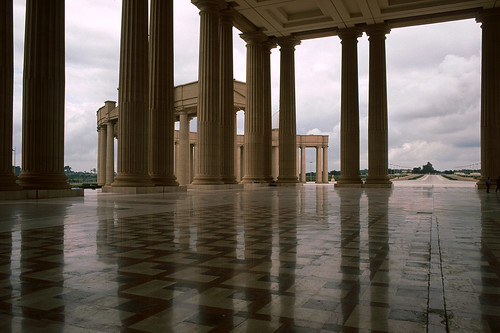
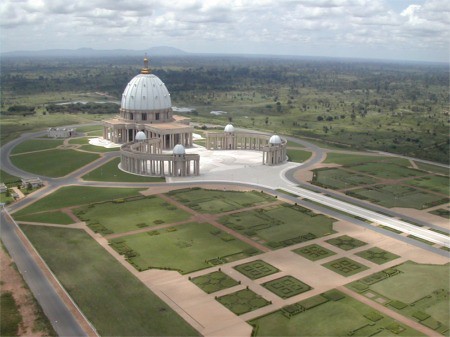
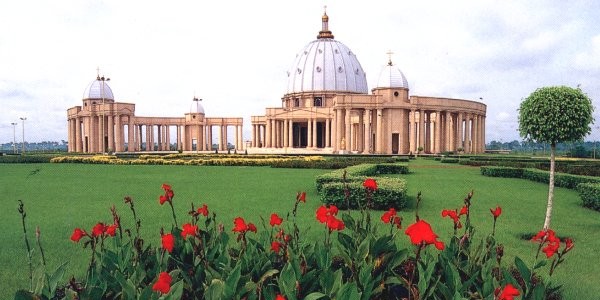
This is very bizarre. The largest church building in the world is in a fairly small city with a tiny Catholic population. But it looks like a fascinating place, so enjoy the pictures and some good info from The Epoch Times:
The world's largest Christian church has 7,000 individually air-conditioned seats, standing-room for 11,000 in a surrounding 3ha marble plaza, and enough room for 100,000 more – 300,000 at a squeeze – beyond that.
Yet the chances of even the 7,000 seats ever all being occupied at one time are about nil, because rather than finding this church in one of the great cities of the world, you'll discover it in a community of just 120,000 people in the middle of the jungled hills, arid plains and farmlands of Africa's Ivory Coast.
And poverty, for few homes away from this city's strange CBD have even the basics of running water and sanitation.
We're talking about Yamoussoukro, the Ivory Coast's capital, and it's unusual Roman Catholic Basilica of Our Lady of Peace.
Which is the more bizarre is a matter of conjecture. Twenty-odd years ago the country's then-President, Felix Houphouet-Boigny decided that the little village of Yamoussoukro, his birthplace, would become the country's new capital.
He enthusiastically set about the conversion, building with his own and taxpayer money, universities, hotels, an 18-hole golf course for visiting dignitaries, lush parklands, boarding schools, and eight-lane boulevards to link the lot.
Plus an airport that was the only one in Africa big enough to take the Concorde, a presidential palace with a lake stocked with scores of Sacred Caymans (crocodiles,) and the Basilica of Our Lady of Peace.
And while visitors today still land at that airport, can play 18-holes, stay and dine 5-star at the swank 15-storey Hotel President (naturally,) find themselves on boulevards to nowhere, and watch the afternoon feeding of the crocodiles at the palace, it's the Basilica they want to see.
(And amidst all else, they discover a scattering of government buildings, modern and traditional stores and businesses, and homes of the less well-off.)
Modelled largely along the lines of St Peter's in Rome that took 109 years to build, the Yamoussoukro Basilica cost USD$300m and took 1,500 largely-Ivorians just three years to construct.
President Houphouet-Boigny thought it only appropriate that Pope John Paul II officially consecrate the building, but when the Vatican learned that its African St Peter's look-alike was going to be higher than the original, it laid down two rules: one was that the dome of Yamoussoukro Basilica not be higher than St Peter's, and the other that a hospital for the poor be built near the new church.
The President concurred… but somehow, just somehow, the cross on his Basilica is 17m higher than that of St Peter's. [...]
Tuesday, February 26, 2008
Sudanese Impressions
Some recent travelers to Sudan talk about their time in Khartoum, it's not a long read:
[...]First of all, Sudan is the first country we have visited that is not really a tourist destination. A lot of people, for instance, dream of visiting Egypt or Morocco--and even Jordan--but never have we heard anyone speak of a yearning to visit Sudan. We like to do a little bit of basic research before going anywhere, but there is no "Lonely Planet" Sudan travel guidebook, and surprisingly the Internet doesn't provide much information either. Even finding a map of Sudan--when we were in Sudan--was difficult. That Sudan is not a travel hot spot--and that the government doesn't seem to care that it isn't--in itself made our trip different from others we have taken.[...]
Read it all at Mishmish.
[...]First of all, Sudan is the first country we have visited that is not really a tourist destination. A lot of people, for instance, dream of visiting Egypt or Morocco--and even Jordan--but never have we heard anyone speak of a yearning to visit Sudan. We like to do a little bit of basic research before going anywhere, but there is no "Lonely Planet" Sudan travel guidebook, and surprisingly the Internet doesn't provide much information either. Even finding a map of Sudan--when we were in Sudan--was difficult. That Sudan is not a travel hot spot--and that the government doesn't seem to care that it isn't--in itself made our trip different from others we have taken.[...]
Read it all at Mishmish.
Friday, February 22, 2008
Raymund Llull: First Missionary to the Moslems
The entire text to this book which I just quoted is available online. It is a quick read and very well-written. Very engaging book really. Lull is an awe-inspiring individual. Certainly one of my greatest heroes--now more than ever.
And did I mention it was written by Samuel Zwemer? Himself a father of Protestant missions to Muslims?!
Raymund Lull: First Missionary to the Moslems
And did I mention it was written by Samuel Zwemer? Himself a father of Protestant missions to Muslims?!
Raymund Lull: First Missionary to the Moslems
Saturday, February 02, 2008
Mideast fertility rates plunge
If you have read Clash of Civilizations (which you should read) you would know why this is very important information.
Mideast fertility rates plunge
Mideast fertility rates plunge
Subscribe to:
Posts (Atom)