Augustine on evil as lack of being:
To thee there is no such thing as evil, and even in thy whole creation taken as a whole, there is not; because there is nothing from beyond it that can burst in and destroy the order which thou hast appointed for it. But in the parts of creation, some things, because they do not harmonize with others, are considered evil. Yet those same things harmonize with others and are good, and in themselves are good. And all these things which do not harmonize with each other still harmonize with the inferior part of creation which we call the earth, having its own cloudy and windy sky of like nature with itself.
Confessions 7:13
What a fount of comfort and wisdom is this great African saint.
Showing posts with label judgment. Show all posts
Showing posts with label judgment. Show all posts
Friday, July 08, 2011

Saturday, May 09, 2009
Hadith on Muhammad as Savior
Sahih Muslim, Book 30, Number 5655:
Abu Huraira reported Allah's Messenger (may peace be upon him) as saying: I shall be pre-eminent amongst the descendants of Adam on the Day of Resurrection and I will be the first intercessor and the first whose intercession will be accepted (by Allah).
Abu Huraira reported Allah's Messenger (may peace be upon him) as saying: I shall be pre-eminent amongst the descendants of Adam on the Day of Resurrection and I will be the first intercessor and the first whose intercession will be accepted (by Allah).
Wednesday, November 12, 2008
Blood Atonement in Shi'a Islam
From HERE:
Islam is divided into many sects, the two major ones being the Sunnis and the Shias. The original split between the latter two was over the question of who should succeed Muhammad as leader of the community. The Shias felt the leader should come from Muhammad's family; the Sunnis thought he should be someone of noted piety elected by and from Muhammad's closest companions. The Sunnis won with the first three successors; then the Shias, or party of Ali, assumed the leadership. But Ali was martyred, as were his only two sons (more on this shortly).
Down through the centuries, the Shias usually lost out in these power struggles. This led to their taking on the nature of a protest movement against the corrupt Sunni leaders. Inevitably, to justify their separate minority identity, they developed theological doctrines that radically differed from those of the Sunnis on at least two major points: the idea of martyrdom and the idea of divine light indwelling their leaders. Both these beliefs open up Shias to Christian witness in a way not possible among the Sunnis.
Martyrdom for the cause of the people is memorialized in the Shia calendar year during their lunar month of Muharram. Of the three martyrs mentioned above -- Ali (Muhammad's cousin and son-in-law) and Ali's two sons, Hasan and Husayn (Muhammad's grandsons) -- that of Husayn is celebrated annually. The first ten days of the month of Muharram are dedicated to "passion plays" that retell the story of Husayn's betrayal and courageous stand, facing overwhelming odds, against the ruling house of Mecca (the Umayyids). On the tenth day, it is common for parades of self-flagellating men to beat themselves until the blood flows, lamenting the failure of the people to come to the defense of their beloved leader.
This brings us to the key point: Shias believe that the shed blood of their slain leader atones for their sins. They accept the concept of atonement -- an idea totally unacceptable to the Sunnis. Of all the approaches I've seen Christians use in witnessing to the Shias, the most effective is through films depicting the crucifixion of Jesus Christ. (By the way, unlike Sunnis, Shias accept art forms depicting human beings, and practice drama.) I have seen them weep profusely while viewing such films. Afterwards, it is easy to speak to them of the deep spiritual meaning of the suffering and death of Jesus Christ.
--Don McCurry
Islam is divided into many sects, the two major ones being the Sunnis and the Shias. The original split between the latter two was over the question of who should succeed Muhammad as leader of the community. The Shias felt the leader should come from Muhammad's family; the Sunnis thought he should be someone of noted piety elected by and from Muhammad's closest companions. The Sunnis won with the first three successors; then the Shias, or party of Ali, assumed the leadership. But Ali was martyred, as were his only two sons (more on this shortly).
Down through the centuries, the Shias usually lost out in these power struggles. This led to their taking on the nature of a protest movement against the corrupt Sunni leaders. Inevitably, to justify their separate minority identity, they developed theological doctrines that radically differed from those of the Sunnis on at least two major points: the idea of martyrdom and the idea of divine light indwelling their leaders. Both these beliefs open up Shias to Christian witness in a way not possible among the Sunnis.
Martyrdom for the cause of the people is memorialized in the Shia calendar year during their lunar month of Muharram. Of the three martyrs mentioned above -- Ali (Muhammad's cousin and son-in-law) and Ali's two sons, Hasan and Husayn (Muhammad's grandsons) -- that of Husayn is celebrated annually. The first ten days of the month of Muharram are dedicated to "passion plays" that retell the story of Husayn's betrayal and courageous stand, facing overwhelming odds, against the ruling house of Mecca (the Umayyids). On the tenth day, it is common for parades of self-flagellating men to beat themselves until the blood flows, lamenting the failure of the people to come to the defense of their beloved leader.
This brings us to the key point: Shias believe that the shed blood of their slain leader atones for their sins. They accept the concept of atonement -- an idea totally unacceptable to the Sunnis. Of all the approaches I've seen Christians use in witnessing to the Shias, the most effective is through films depicting the crucifixion of Jesus Christ. (By the way, unlike Sunnis, Shias accept art forms depicting human beings, and practice drama.) I have seen them weep profusely while viewing such films. Afterwards, it is easy to speak to them of the deep spiritual meaning of the suffering and death of Jesus Christ.
--Don McCurry
Saturday, March 22, 2008
The Harrowing of Hell
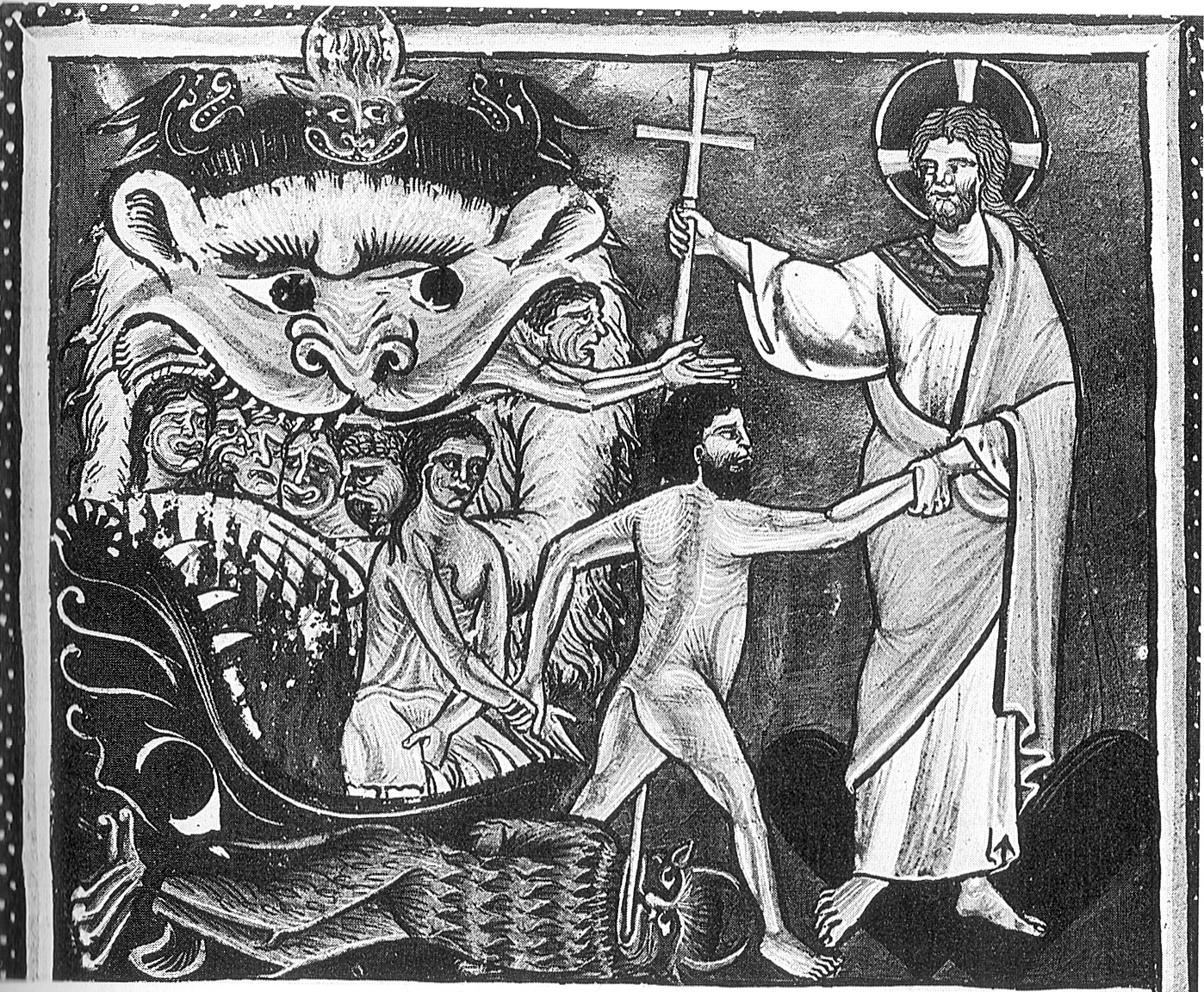
Holy Saturday: Christ descends to the grave and opens the gates for the righteous deceased.
Tuesday, March 18, 2008
Erik Twist, Purgatory, and "Decision"
From Part IX:
...The Protestant notion of salvation is an all-in-one, instantaneous occurrence where the deal is sealed upon "conversion." Today the supposition is that such an event takes place once an individual "prays the sinner's prayer." I've been to many an evangelical rally, a few of which have been Promise Keepers events. At the last one I went to in San Antonio (3 years before Catholicism became a serious possibility) I remember being very turned off by the way salvation was articulated during the "altar call". The usual evangelical process was undertaken; lights were dimmed, the band played some ethereal tune in the background, and the "leader" spoke passionately about the benefits of a life with Christ. As droves of people came forward they were encouraged to fill out "Decision Cards" that were being passed out around the arena.
My good friend Duane Miller was with me and we reflected on the implications of referring to conversion as a "decision". In many ways it is quite innocent and probably mostly reflects the desire for Promise Keepers to keep a tally on how well their rallies are doing in "spreading the gospel." And there is certainly an element of personal decision in the spiritual life. The problem with it, we thought, was how reductionist it ends up being. [...]
...The Protestant notion of salvation is an all-in-one, instantaneous occurrence where the deal is sealed upon "conversion." Today the supposition is that such an event takes place once an individual "prays the sinner's prayer." I've been to many an evangelical rally, a few of which have been Promise Keepers events. At the last one I went to in San Antonio (3 years before Catholicism became a serious possibility) I remember being very turned off by the way salvation was articulated during the "altar call". The usual evangelical process was undertaken; lights were dimmed, the band played some ethereal tune in the background, and the "leader" spoke passionately about the benefits of a life with Christ. As droves of people came forward they were encouraged to fill out "Decision Cards" that were being passed out around the arena.
My good friend Duane Miller was with me and we reflected on the implications of referring to conversion as a "decision". In many ways it is quite innocent and probably mostly reflects the desire for Promise Keepers to keep a tally on how well their rallies are doing in "spreading the gospel." And there is certainly an element of personal decision in the spiritual life. The problem with it, we thought, was how reductionist it ends up being. [...]
Wednesday, March 12, 2008
Erik Twist and the J word
In PART 7 he tackles justification, one section is here:
Essentially, justification was not simply a declaration about my status before God, instantaneously achieved at the point of my "conversion." It was organically tied to the sanctification Christ began in me at my baptism and each day offers my participation in. Just as I needed to be physically generated to enter into the world, at my baptism my soul was regenerated so as to enter into God's kingdom. This spiritual regeneration must be lived into though. Just as my physical regeneration requires appropriate action (eating, sleeping, etc.) my spiritual regeneration requires the same. The salvation that Christ affects is not a badge to be worn, but a lifestyle to be appropriated; our reconstituted being orients and directs our becoming.
Essentially, justification was not simply a declaration about my status before God, instantaneously achieved at the point of my "conversion." It was organically tied to the sanctification Christ began in me at my baptism and each day offers my participation in. Just as I needed to be physically generated to enter into the world, at my baptism my soul was regenerated so as to enter into God's kingdom. This spiritual regeneration must be lived into though. Just as my physical regeneration requires appropriate action (eating, sleeping, etc.) my spiritual regeneration requires the same. The salvation that Christ affects is not a badge to be worn, but a lifestyle to be appropriated; our reconstituted being orients and directs our becoming.
Tuesday, February 26, 2008
Saint Clement of Rome on justification
Clement of Rome (AD 30-100) was a personal friend of Paul's and is thought to be, after Peter, Linus, and Cletus, the fourth bishop of the Roman church (what would later be called the Pope).
He is, to my knowledge, the earliest of the Church Fathers whose writing still exists. This is a challenge to Muslims who find in the New Testament many spurious doctrines that they claim have been corrupted from the original injiil which Jesus son of Mary ('Issa bin Maryam) received from Allah. The probable date of this letter is around 97 AD, though some put it earlier. That means it was completed in the same decade as the Gospel according to St John.
Here is a brief section on justification by faith in this very early work, which was read widely in the ancient churches. This is from his letter, written on behalf of his church in Rome to the church in Corinth.
All these [OT figures], therefore, were highly honoured, and made great, not for their own sake, or for their own works, or for the righteousness which they wrought, but through the operation of His will. And we, too, being called by His will in Christ Jesus, are not justified by ourselves, nor by our own wisdom, or understanding, or godliness, or works which we have wrought in holiness of heart; but by that faith through which, from the beginning, Almighty God has justified all men; to whom be glory for ever and ever. Amen.
1 Clement 32
He is, to my knowledge, the earliest of the Church Fathers whose writing still exists. This is a challenge to Muslims who find in the New Testament many spurious doctrines that they claim have been corrupted from the original injiil which Jesus son of Mary ('Issa bin Maryam) received from Allah. The probable date of this letter is around 97 AD, though some put it earlier. That means it was completed in the same decade as the Gospel according to St John.
Here is a brief section on justification by faith in this very early work, which was read widely in the ancient churches. This is from his letter, written on behalf of his church in Rome to the church in Corinth.
All these [OT figures], therefore, were highly honoured, and made great, not for their own sake, or for their own works, or for the righteousness which they wrought, but through the operation of His will. And we, too, being called by His will in Christ Jesus, are not justified by ourselves, nor by our own wisdom, or understanding, or godliness, or works which we have wrought in holiness of heart; but by that faith through which, from the beginning, Almighty God has justified all men; to whom be glory for ever and ever. Amen.
1 Clement 32
Sunday, August 26, 2007
"Strive to enter through the narrow gate."
From Mike Liccione, commenting on this Gospel passage:
He makes this important point:
On an obvious, historical level, Jesus seems to be speaking about certain Jews of his day. Assuming he himself is the "master of the house," he has himself saying someday to certain people in the parable "I don't know where you come from," banishing them permanently from the household of God they want to enter. Not a few Jews of Jesus' day rejected him despite having eaten and drunk in his company and heard him teach in the streets. And Jesus duly warns them. But it's never that simple. The Lord's words apply as much to the future, to his Church, the new Israel, as to those present when he walked the earth. It is quite conceivable that some who are baptized, who are raised in the true Faith, who go to church and take communion often, will find themselves being told at the end "I don't know where you're from. Depart, evildoers!" Some people who are formally in the Church, the household of God, are not followers of Christ in their hearts, despite claiming to be and having a velleity, as distinct from a will, to do so. And they show that by how they live.
Strive to enter through the narrow gate, for many, I tell you, will attempt to enter but will not be strong enough.
After the master of the house has arisen and locked the door, then will you stand outside knocking and saying, 'Lord, open the door for us.' He will say to you in reply, 'I do not know where you are from.' And you will say, 'We ate and drank in your company and you taught in our streets.' Then he will say to you, 'I do not know where (you) are from. Depart from me, all you evildoers!'
And there will be wailing and grinding of teeth when you see Abraham, Isaac, and Jacob and all the prophets in the kingdom of God and you yourselves cast out.
He makes this important point:
On an obvious, historical level, Jesus seems to be speaking about certain Jews of his day. Assuming he himself is the "master of the house," he has himself saying someday to certain people in the parable "I don't know where you come from," banishing them permanently from the household of God they want to enter. Not a few Jews of Jesus' day rejected him despite having eaten and drunk in his company and heard him teach in the streets. And Jesus duly warns them. But it's never that simple. The Lord's words apply as much to the future, to his Church, the new Israel, as to those present when he walked the earth. It is quite conceivable that some who are baptized, who are raised in the true Faith, who go to church and take communion often, will find themselves being told at the end "I don't know where you're from. Depart, evildoers!" Some people who are formally in the Church, the household of God, are not followers of Christ in their hearts, despite claiming to be and having a velleity, as distinct from a will, to do so. And they show that by how they live.
Friday, August 24, 2007
Justification
Fletcher and I have been having an extended conversation about all things Christian, with an emphasis on Catholicism. So here is the main section on justification in the Catholic Catechism. Would like to know what you all think. What are its strengths and weaknesses?
I would also like to hear the opinion of our Muslim readers on this topic. FYI the word we use in Arabic for "justification" is "tabriir" and the verb in its root is "barrar":
From Here. Please continue to read as it introduces baptism, which will be a more divisive point.
I would also like to hear the opinion of our Muslim readers on this topic. FYI the word we use in Arabic for "justification" is "tabriir" and the verb in its root is "barrar":
GRACE AND JUSTIFICATION
I. JUSTIFICATION
1987 The grace of the Holy Spirit has the power to justify us, that is, to cleanse us from our sins and to communicate to us "the righteousness of God through faith in Jesus Christ" and through Baptism:
But if we have died with Christ, we believe that we shall also live with him. For we know that Christ being raised from the dead will never die again; death no longer has dominion over him. The death he died he died to sin, once for all, but the life he lives he lives to God. So you also must consider yourselves as dead to sin and alive to God in Christ Jesus.
1988 Through the power of the Holy Spirit we take part in Christ's Passion by dying to sin, and in his Resurrection by being born to a new life; we are members of his Body which is the Church, branches grafted onto the vine which is himself:
[God] gave himself to us through his Spirit. By the participation of the Spirit, we become communicants in the divine nature. . . . For this reason, those in whom the Spirit dwells are divinized.
1989 The first work of the grace of the Holy Spirit is conversion, effecting justification in accordance with Jesus' proclamation at the beginning of the Gospel: "Repent, for the kingdom of heaven is at hand." Moved by grace, man turns toward God and away from sin, thus accepting forgiveness and righteousness from on high. "Justification is not only the remission of sins, but also the sanctification and renewal of the interior man.
1990 Justification detaches man from sin which contradicts the love of God, and purifies his heart of sin. Justification follows upon God's merciful initiative of offering forgiveness. It reconciles man with God. It frees from the enslavement to sin, and it heals.
1991 Justification is at the same time the acceptance of God's righteousness through faith in Jesus Christ. Righteousness (or "justice") here means the rectitude of divine love. With justification, faith, hope, and charity are poured into our hearts, and obedience to the divine will is granted us.
From Here. Please continue to read as it introduces baptism, which will be a more divisive point.
Sunday, August 19, 2007
"The Earth on Fire"
Mike Liccione over at Sacramentum Vitae comments on these verses from Luke 12:
I have come to set the earth on fire, and how I wish it were already blazing! There is a baptism with which I must be baptized, and how great is my anguish until it is accomplished!
Do you think that I have come to establish peace on the earth? No, I tell you, but rather division. From now on a household of five will be divided, three against two and two against three; a father will be divided against his son and a son against his father, a mother against her daughter and a daughter against her mother, a mother-in-law against her daughter-in-law and a daughter-in-law against her mother-in-law."
[...]
The reason I love this passage is its clear implication that those who follow Jesus must draw a sharp line in the sand that will not be erased with the soft passage of time. I don't mean the obvious line we draw against certain kinds of felonies; among Nice People Like Us, that is uncontroversial. I mean the line to be drawn between Truth and Untruth. That is controversial. For just as in the ancient Roman Empire, relativism is popular today as the default option for getting along with people who are different: what's "true for me" is not "true for you," as they say; I'm OK and you're OK. To be sure, that attitude is often appropriate when we're dealing with matters of taste. It is sometimes appropriate even when we're dealing with disagreements about the best means to attain agreed-upon ends, which is really what many political disagreements are about. For sometimes there is no single "right" resolution to such issues. But when it comes to ultimates, such an attitude will not do at all. If Jesus really is what Scripture, Tradition, and the teaching authority of the Church together present him to be, then the only appropriate attitude toward him is complete faith and surrender, which entails being baptized with suffering. That was the life, and death, of many of the early Christians. And if Jesus is not what they collectively present him to be, then the only appropriate attitude is to dismiss him as one more deluded would-be messiah, even crazier than the ones the Romans brutally crushed both before him and after him—though without, as in Jesus' case, the active collusion of the Jewish leadership.
There have been many attempts, mostly among modern, "scientific" biblical scholars, to evade that choice and thus to brush away the line in the sand. Thomas Jefferson, judicious editor of the Jefferson Bible, was a good example of how intelligent people can cut Jesus down to their own size. As an antidote to that sort of thing, I recommend the Pope's book Jesus of Nazareth. But evading the choice is not just an intellectual phenomenon. Because we are all sinners, we all do it sometimes in our own egregious ways and, more insidiously, our sneaky little ways. We make compromises all the time hoping, for example, to avoid trouble with that ol' mother-in-law Jesus alludes to. There are countless other compromises. Sometimes we compromise faith itself, because conformity to popular opinion, relativism, or just cynical skepticism wins us more points and costs us less than orthodox, undiluted belief. Always we compromise our virtue—or at least put off the development of virtue—because that's easier and more gratifying than dying to self so that He might live in us. And often we can't be honest with ourselves, or even with God, because we're afraid of paying the bill that fully facing the truth would present to us.
In anything pertaining to the spiritual life, we must prefer honesty to niceness. Of course we'd thereby create much division. But we'd be on the right side of that line in the sand.
I have come to set the earth on fire, and how I wish it were already blazing! There is a baptism with which I must be baptized, and how great is my anguish until it is accomplished!
Do you think that I have come to establish peace on the earth? No, I tell you, but rather division. From now on a household of five will be divided, three against two and two against three; a father will be divided against his son and a son against his father, a mother against her daughter and a daughter against her mother, a mother-in-law against her daughter-in-law and a daughter-in-law against her mother-in-law."
[...]
The reason I love this passage is its clear implication that those who follow Jesus must draw a sharp line in the sand that will not be erased with the soft passage of time. I don't mean the obvious line we draw against certain kinds of felonies; among Nice People Like Us, that is uncontroversial. I mean the line to be drawn between Truth and Untruth. That is controversial. For just as in the ancient Roman Empire, relativism is popular today as the default option for getting along with people who are different: what's "true for me" is not "true for you," as they say; I'm OK and you're OK. To be sure, that attitude is often appropriate when we're dealing with matters of taste. It is sometimes appropriate even when we're dealing with disagreements about the best means to attain agreed-upon ends, which is really what many political disagreements are about. For sometimes there is no single "right" resolution to such issues. But when it comes to ultimates, such an attitude will not do at all. If Jesus really is what Scripture, Tradition, and the teaching authority of the Church together present him to be, then the only appropriate attitude toward him is complete faith and surrender, which entails being baptized with suffering. That was the life, and death, of many of the early Christians. And if Jesus is not what they collectively present him to be, then the only appropriate attitude is to dismiss him as one more deluded would-be messiah, even crazier than the ones the Romans brutally crushed both before him and after him—though without, as in Jesus' case, the active collusion of the Jewish leadership.
There have been many attempts, mostly among modern, "scientific" biblical scholars, to evade that choice and thus to brush away the line in the sand. Thomas Jefferson, judicious editor of the Jefferson Bible, was a good example of how intelligent people can cut Jesus down to their own size. As an antidote to that sort of thing, I recommend the Pope's book Jesus of Nazareth. But evading the choice is not just an intellectual phenomenon. Because we are all sinners, we all do it sometimes in our own egregious ways and, more insidiously, our sneaky little ways. We make compromises all the time hoping, for example, to avoid trouble with that ol' mother-in-law Jesus alludes to. There are countless other compromises. Sometimes we compromise faith itself, because conformity to popular opinion, relativism, or just cynical skepticism wins us more points and costs us less than orthodox, undiluted belief. Always we compromise our virtue—or at least put off the development of virtue—because that's easier and more gratifying than dying to self so that He might live in us. And often we can't be honest with ourselves, or even with God, because we're afraid of paying the bill that fully facing the truth would present to us.
In anything pertaining to the spiritual life, we must prefer honesty to niceness. Of course we'd thereby create much division. But we'd be on the right side of that line in the sand.
Tuesday, July 31, 2007
Consider Islamophobia
Whoever coined the term "Islamophobia" was quite shrewd. Notice the intellectual sleight of hand here. The term is not "Muslim-phobia" or "anti-Muslimist," it is Islam-ophobia – fear of Islam – yet fear of Islam is in no way the same as hatred of all Muslims. One can rightly or wrongly fear Islam, or more usually, aspects of Islam, and have absolutely no bias against all Muslims, let alone be a racist.
The equation of Islamophobia with racism is particularly dishonest. Muslims come in every racial group, and Islam has nothing to do with race. Nevertheless, mainstream Western media, Islamist groups calling themselves Muslim civil liberties groups and various Western organizations repeatedly declare that Islamophobia is racism.
--Dennis Prager
The equation of Islamophobia with racism is particularly dishonest. Muslims come in every racial group, and Islam has nothing to do with race. Nevertheless, mainstream Western media, Islamist groups calling themselves Muslim civil liberties groups and various Western organizations repeatedly declare that Islamophobia is racism.
--Dennis Prager
Tuesday, June 12, 2007
A Fatwa Free-for-all in the Islamic World
What is a fatwa exactly? It is a legal ruling. Since in Islam there is no separation between civil and religious rule, the fatwa can address almost any facte of life, from real estate, to jihad, to dietary rules, to travel rules, and so on.
Do Christians have anything equivalent to the fatwa? Not really. Sunni Islam is much like Protestantism in that there is no central authority, and just as Protestants and evangelicals divide into new denominations on a daily basis, you find the same thing in the Muslim world. The proliferation of fatwas is a result of this process.
Read it all HERE.
Do Christians have anything equivalent to the fatwa? Not really. Sunni Islam is much like Protestantism in that there is no central authority, and just as Protestants and evangelicals divide into new denominations on a daily basis, you find the same thing in the Muslim world. The proliferation of fatwas is a result of this process.
CAIRO: First came the breast-feeding fatwa: It declared that the Islamic restriction on unmarried men and women being together could be lifted at work if the woman breast-fed her male colleagues five times. Then came the urine fatwa: It said that drinking the urine of the Prophet Muhammad was deemed a blessing.
For the past few weeks, the breast-feeding and urine fatwas have proved a source of national embarrassment in Egypt, not least because they were issued by representatives of the highest religious authorities in the land.
"We were very angered when we heard about the Danish cartoons concerning our Prophet," wrote Galal Amin in the newspaper Al Masry Al Yom, referring to the 2005 publication of cartoons of the Prophet Muhammad that caused an international uproar. "However, these two fatwas are harming our Islamic religion and our Prophet more than the cartoons."
For many Muslims, fatwas, or religious edicts, are the bridge between the principles of their faith and modern life. They are supposed to be issued by religious scholars who look to the Koran and teachings of the Prophet Muhammad for guidance.
Read it all HERE.
Wednesday, April 18, 2007
In Whose Name have you Come?
Something I wrote to a Muslim friend, part of a much larger apologetic work.
Dear Abed,
Peace be with you.
Now when a man and a woman are married to each other in the mystery of the Crowns, as it is called in the East, or in the sacrament of Holy Matrimony, as we call it in the West, they become one flesh before God. In the same way, though we are sinful and enemies of God, though we bring shame upon him by our ignorance and disobedience, we may be saved by being united to the Messiah. For Noah’s whole family was saved from God’s judgment upon the whole earth; but Noah alone among them was righteous. And when God wanted to destroy the tribes of Jacob, Moses who alone among them was humble, and he interceded before God, and God relented. He relented for the sake of this one man who was humble and who was a friend of God. And when the first apostles (mursaliin or hawarriyuun) of Jesus went to the pagans, they found a God-fearing man name Cornelius. Cornelius believed in the Gospel, but his whole household was saved and entered into the Kingdom of God that day; and that day they were baptized as Jesus had commanded.
So there is only one person who does not have a debt towards God and that is Jesus, only one person who has not brought shame upon God’s holy name. Now in Islam some people say that the prophets gain the benefit of being immune from sin after they receive their calling. But before they receive their calling they are not immune. So even the prophets who lived upright lives did sin at times, and as such showed that they needed to repent and confess their sins to God, asking for forgiveness and mercy on the day of judgment.
But there is one man in all of history who did not bring shame upon God’s name, and that is Jesus. And Jesus has entered into the fullness of God’s light and glory because he alone was obedient to God’s commands. So it is in his name that we approach God when we ask for mercy or forgiveness. These concepts are indeed present in Islam, but they are flawed. For will you come before the throne of God in your own name? You, a sinner and enemy of God? And when you come before his throne what will you say when the Judge asks why he should forgive you? Will you say, for the sake of Mohammad? “But Mohammad is there next to you asking for mercy. So how can you come in his name?” God will answer.
I will be there by your side on that day friend, for you and I are the same. And the greatest prophets will be there and the most reprobate sinners will be there too. And we will see on that day that all of our righteous deeds are like menstruated rags before the purity and holiness of God.
So what will you say? Will you say I kept the pillars of Islam without any flaw, I kept them perfectly? Who can say such a thing? In that day the Qu’ran itself will testify against you and reveal that your obedience was not flawless.
And on that day the Torah and the Injil will testify against me as well friend. But the difference is this: I will plead with God and say, I am not here in my own name, but in the name of the single person who obeyed you: Jesus. I believe in his name and am baptized into his wife, the Church. Will you Almighty God deny the one who obeyed you a wife for eternity?
And God will say, if you came in your own name, or of some other man, then you would receive what you deserve. But Messiah will surely bring his bride into Paradise. And so it is that we who follow Jesus have a hope for the day of salvation. If you plan on coming to God in your own name, or the name of some other sinner, on the day of judgment, then beware. Prepare your answer as to why God should even allow you to plead your case.
If I came to this Kingdom’s king in my own name I will not even be given a hearing. If I come to him as a representative of the President of my own country, then I will be received generously and with great honor. And so it is with God.
Peace.
Abu Daoud
Dear Abed,
Peace be with you.
Now when a man and a woman are married to each other in the mystery of the Crowns, as it is called in the East, or in the sacrament of Holy Matrimony, as we call it in the West, they become one flesh before God. In the same way, though we are sinful and enemies of God, though we bring shame upon him by our ignorance and disobedience, we may be saved by being united to the Messiah. For Noah’s whole family was saved from God’s judgment upon the whole earth; but Noah alone among them was righteous. And when God wanted to destroy the tribes of Jacob, Moses who alone among them was humble, and he interceded before God, and God relented. He relented for the sake of this one man who was humble and who was a friend of God. And when the first apostles (mursaliin or hawarriyuun) of Jesus went to the pagans, they found a God-fearing man name Cornelius. Cornelius believed in the Gospel, but his whole household was saved and entered into the Kingdom of God that day; and that day they were baptized as Jesus had commanded.
So there is only one person who does not have a debt towards God and that is Jesus, only one person who has not brought shame upon God’s holy name. Now in Islam some people say that the prophets gain the benefit of being immune from sin after they receive their calling. But before they receive their calling they are not immune. So even the prophets who lived upright lives did sin at times, and as such showed that they needed to repent and confess their sins to God, asking for forgiveness and mercy on the day of judgment.
But there is one man in all of history who did not bring shame upon God’s name, and that is Jesus. And Jesus has entered into the fullness of God’s light and glory because he alone was obedient to God’s commands. So it is in his name that we approach God when we ask for mercy or forgiveness. These concepts are indeed present in Islam, but they are flawed. For will you come before the throne of God in your own name? You, a sinner and enemy of God? And when you come before his throne what will you say when the Judge asks why he should forgive you? Will you say, for the sake of Mohammad? “But Mohammad is there next to you asking for mercy. So how can you come in his name?” God will answer.
I will be there by your side on that day friend, for you and I are the same. And the greatest prophets will be there and the most reprobate sinners will be there too. And we will see on that day that all of our righteous deeds are like menstruated rags before the purity and holiness of God.
So what will you say? Will you say I kept the pillars of Islam without any flaw, I kept them perfectly? Who can say such a thing? In that day the Qu’ran itself will testify against you and reveal that your obedience was not flawless.
And on that day the Torah and the Injil will testify against me as well friend. But the difference is this: I will plead with God and say, I am not here in my own name, but in the name of the single person who obeyed you: Jesus. I believe in his name and am baptized into his wife, the Church. Will you Almighty God deny the one who obeyed you a wife for eternity?
And God will say, if you came in your own name, or of some other man, then you would receive what you deserve. But Messiah will surely bring his bride into Paradise. And so it is that we who follow Jesus have a hope for the day of salvation. If you plan on coming to God in your own name, or the name of some other sinner, on the day of judgment, then beware. Prepare your answer as to why God should even allow you to plead your case.
If I came to this Kingdom’s king in my own name I will not even be given a hearing. If I come to him as a representative of the President of my own country, then I will be received generously and with great honor. And so it is with God.
Peace.
Abu Daoud
Subscribe to:
Posts (Atom)