G. K. Chesterton defined tradition as "democracy extended through time," and for Eliot, tradition offered the advantages of democracy -- diverse viewpoints and a protection against tyranny -- nestled in the cocoon of time. Apart from tradition, democracy could too easily degenerate into hysteria. Eliot saw this as a particular danger in industrial society, which creates "people detached from tradition, alienated from religion, and susceptible to mass suggestion: in other words a mob. And a mob will be no less a mob if it is well fed, well clothed, well housed, and well disciplined" (Idea, p. 21) To guard against these moblike tendencies, Eliot lent his support to a class system.
Philip Yancey writing on Eliot. Read it all here.
And this is what the West wants for the Arab world? Say it ain't so...
Showing posts sorted by relevance for query eliot. Sort by date Show all posts
Showing posts sorted by relevance for query eliot. Sort by date Show all posts
Friday, July 15, 2011

Wednesday, February 20, 2013
T. S. Eliot on religion and history
T. S. Eliot is one of my great heroes and has deeply influenced my own understanding of religion, civilization, history and more.
I really liked this passage from an essay by Roger Scruton titled 'T S Eliot as Conservative Mentor':
I really liked this passage from an essay by Roger Scruton titled 'T S Eliot as Conservative Mentor':
For Eliot, however, religion in general, and the Christian religion in particular, should not be seen merely in Platonic terms as an attitude towards what is eternal and unchanging. The truth of our condition is that we are historical beings who find whatever consolation and knowledge is vouchsafed to us in time. The consolations of religion come to us in temporal costume, through institutions that are alive with the spirit of history. To rediscover our religion is not to rise free from the temporal order; it is not to deny history and corruption, in order to contemplate the timeless truths. On the contrary, it is to enter more deeply into history, so as to find in the merely transitory the mark and the sign of that which never passes: it is to discover the "point of intersection of the timeless with time," which is, according to Four Quartets, the occupation of the saint.Read it all here.
Wednesday, August 22, 2007
"Redeeming Time"
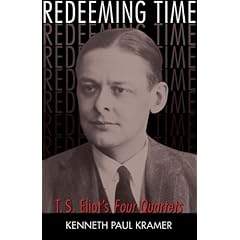

So what am I reading these days? I just started this book yesterday and am finding it very nurturing, both spiritually as a Christian and intellectually as a scholar (or wannabe scholar).
TS Eliot is my favorite poet, and in my view, a prophet through and through. He is in many ways one of my heroes. He and CS Lewis were both Anglicans and were both significant in bringing me into and keeping me in Anglican Christianity. Lewis is beloved for being able to reduce complex and nuanced notions to simple phrases. I love Lewis, but Eliot was very invested in larger questions about philosophy, theology, metaphysics, culture, history, sacramentalogy--you name it. "Redeeming Time" is a book about Eliot's final major poem and masterpiece, Four Quartets. He deals with issues of Christian mysticism, redemption, time, and identity.
If you haven't read Eliot, or if you have just read his pre-conversion poems (The Wasteland and The Lovesong of J. Alfred Prufrock), or if you have just listened to his children's verse (lyrics from "Cats"), then please pick up his Collected Poems. If you have read Four Quartets, then consider picking up Redeeming Time.
Saturday, July 16, 2011
Bruce Frohnen on T.S. Eliot, culture, and secularization
Eliot’s salient point does not concern the process of secularization; it concerns the definition of culture. For, in Eliot’s view, culture is not and cannot be separated from religion. In the West, culture is part and parcel of the Judeo-Christian tradition. Ironically, our culture’s problem of secularization arises from one of its own defining characteristics: the higher law tradition. The separation of law—and those who would interpret it—from the king, is the source of liberty. That separation has its roots in a religious tradition; the Jewish tradition, in which kings, even when they existed, were viewed as men rather than gods, as servants rather than masters of the laws. Unlike their Gentile neighbors, the Jewish people held their rulers to a law higher than their own will; a law handed down by God and applied equally to all.
From the essay, TS Eliot and the Necessity of Christian Culture, by Bruce Frohnen.
From the essay, TS Eliot and the Necessity of Christian Culture, by Bruce Frohnen.
Friday, January 06, 2012
Eliot on the Epiphany: Journey of the Magi
One of the best poems ever. You can hear him read it himself at Poetry Archive.
Journey of the Magi
by T.S. Eliot
A cold coming we had of it,
Just the worst time of the year
For a journey, and such a long journey:
The was deep and the weather sharp,
The very dead of winter."
And the camels galled, sore-footed, refractory,
Lying down in the melting snow.
There were times we regretted
The summer palaces on slopes, the terraces,
And the silken girls bringing sherbet.
Then the camel men cursing and grumbling
And running away, and wanting their liquor and women,
And the night-fires gong out, and the lack of shelters,
And the cities hostile and the towns unfriendly
And the villages dirty, and charging high prices.:
A hard time we had of it.
At the end we preferred to travel all night,
Sleeping in snatches,
With the voices singing in our ears, saying
That this was all folly.
Then at dawn we came down to a temperate valley,
Wet, below the snow line, smelling of vegetation;
With a running stream and a water-mill beating the darkness,
And three trees on the low sky,
And an old white horse galloped away in the meadow.
Then we came to a tavern with vine-leaves over the lintel,
Six hands at an open door dicing for pieces of silver,
And feet kicking the empty wine-skins.
But there was no information, and so we continued
And arrived at evening, not a moment too soon
Finding the place; it was (you may say) satisfactory.
All this was a long time ago, I remember,
And I would do it again, but set down
This set down
This: were we lead all that way for
Birth or Death? There was a Birth, certainly,
We had evidence and no doubt. I have seen birth and death,
But had thought they were different; this Birth was
Hard and bitter agony for us, like Death, our death.
We returned to our places, these Kingdoms,
But no longer at ease here, in the old dispensation,
With an alien people clutching their gods.
I should be glad of another death.
Friday, December 25, 2009
The Cultivation of Christmas Trees by TS Eliot
The Cultivation of Christmas Trees (1954)
TS Eliot1 There are several attitudes towards Christmas,
2 Some of which we may disregard:
3 The social, the torpid, the patently commercial,
4 The rowdy (the pubs being open till midnight),
5 And the childish---which is not that of the child
6 For whom the candle is a star, and the gilded angel
7 Spreading its wings at the summit of the tree
8 Is not only a decoration, but an angel.
9 The child wonders at the Christmas Tree:
10 Let him continue in the spirit of wonder
11 At the Feast as an event not accepted as a pretext;
12 So that the glittering rapture, the amazement
13 Of the first-remembered Christmas Tree,
14 So that the surprises, delight in new possessions
15 (Each one with its peculiar and exciting smell),
16 The expectation of the goose or turkey
17 And the expected awe on its appearance,
18 So that the reverence and the gaiety
19 May not be forgotten in later experience,
20 In the bored habituation, the fatigue, the tedium,
21 The awareness of death, the consciousness of failure,
22 Or in the piety of the convert
23 Which may be tainted with a self-conceit
24 Displeasing to God and disrespectful to the children
25 (And here I remember also with gratitude
26 St. Lucy, her carol, and her crown of fire):
27 So that before the end, the eightieth Christmas
28 (By "eightieth" meaning whichever is the last)
29 The accumulated memories of annual emotion
30 May be concentrated into a great joy
31 Which shall be also a great fear, as on the occasion
32 When fear came upon every soul:
33 Because the beginning shall remind us of the end
34 And the first coining of the second coming.
Wednesday, January 09, 2008
Eliot on Old Age
Old men should be explorers
Here and there does not matter
We must be still and still moving
Into another intensity.
T.S. Eliot, "East Coker"
Here and there does not matter
We must be still and still moving
Into another intensity.
T.S. Eliot, "East Coker"
Sunday, January 11, 2015
TS Eliot on the First Crusade
I love what Eliot says about the (first) Jerusalem Crusade:
"In spite of all the dishonour,
the broken standards, the broken lives,
The broken faith in one place or another,
There was something left that was more than the tales
Of old men on winter evenings."
From his Choruses from 'the Rock'
"In spite of all the dishonour,
the broken standards, the broken lives,
The broken faith in one place or another,
There was something left that was more than the tales
Of old men on winter evenings."
From his Choruses from 'the Rock'
Thursday, February 07, 2008
Ash Wednesday
From Ash Wednesday, by TS Eliot:
Where shall the word be found, where will the word
Resound? Not here, there is not enough silence
Not on the sea or on the islands, not
On the mainland, in the desert or the rain land,
For those who walk in darkness
Both in the day time and in the night time
The right time and the right place are not here
No place of grace for those who avoid the face
No time to rejoice for those who walk among noise and deny the voice
Wednesday, February 05, 2014
Algerian Christian refused burial in public cemetery
A Christian family in Algeria has been refused permission to bury their son in the local public cemetery because he was not a Muslim.
“The leaders of the mosque demanded that I would have to follow Islamic burial rites if I was to bury my son in the cemetery,” said the father of 24-year-old Lahlou Naraoui, a University student.
Naraoui’s family, who live in Chemini in the Kabylie region of northern Algeria, said they could not follow the Muslim leaders’ demands and instead chose to bury their son on private land.From World Watch Monitor.
But really, in the end this is good. It means that Christians must form their own identity, including places of burial. And in terms of North Africa, this is most fitting, as the first Christians there achieved legal recognition as burial societies, and some of their first real estate was in grave yards.
In the end is my beginning, as TS Eliot said. Indeed.
Friday, December 28, 2007
The Cultivation of Christmas Trees
The Cultivation of Christmas Trees
by TS Eliot
‘There are several attitudes towards Christmas,
Some of which we may disregard:
The social, the torpid, the patently commercial,
The rowdy (with pubs being open till midnight),
And the childish—which is not that of the child
For whom the candle is a star, and the gilded angel
Spreading its wings at the summit of the tree
Is not only a decoration, but an angel.
The child wonders at the Christmas Tree:
Let him continue in the spirit of wonder
At the Feast as an event not accepted as a pretext;
So that the glittering rapture, the amazement
Of the first-remembered Christmas Tree,
So that the surprises, delight in new possessions
(Each one with its peculiar and exciting smell),
The expectation of the goose or turkey
And the expected awe on its appearance,
So that the reverence and the gaiety
May not be forgotten in later experience,
In the bored habituation, the fatigue, the tedium,
The awareness of death, the consciousness of failure,
Or in the piety of the convert
Which may be tainted with a self-conceit
Displeasing to God and disrespectful to the children
(And here I remember also with gratitude
St. Lucy, her carol, and her crown of fire):
So that before the end, the eightieth Christmas
(By ‘eightieth’ meaning whichever is the last)
The accumulated memories of annual emotion
May be concentrated into a great joy
Which shall be also a great fear, as on the occasion
When fear came upon every soul:
Because the beginning shall remind us of the end
And the first coming of the second coming.’
Saturday, July 21, 2007
"It's all quite embarrassing"
There is something beautiful in seeing Christian humility that is genuine. It reminds me of what TS Eliot said, "Humility is endless."
Mike Liccione, upon being asked, Why do you love Jesus? prefaced his answer (which you can read at his blog) like this:
I confess to some reluctance. For one thing, the theme reminds me that I am a sinner, which I am already reminded of rather more than I care to be. Thus, not only do I not love Jesus as much as he loves me, which is a given and inevitable; I don't even love myself as much as he loves me. In fact, I sometimes find myself questioning his judgment for loving me as much as he does; he's a fool for me, with a wisdom greater than I can fathom, let alone muster; and so the truth that I ought to love myself more—or at least more genuinely—than I do is an obligation I need him to help me meet. Then there's the all-too-evident fact that I don't love others as I ought, largely because I don't love him as I ought. It's all quite embarrassing, really.
Subscribe to:
Posts (Atom)