Saturday, April 19, 2008

Madha taqra', ya abu daoud? Churches and Ijtihad

First of all, great link here, where you can listen to a reading of 1st Clement:

Open Source Audio

The sentence above is Arabic for "What are you reading Abu Daoud?" So since the blogosphere is all abuzz with sundry articles about the Pope's American sojourn, I just want to do this thing, where I inexplicably and self-centeredly tell you what I'm reading:

1) Narrow Gate Churches, by Atallah Mansour. Just started it, but so far I really like his writing style. Few books exist about Arab Christianity, few of those are written by Arab Christians. This is one such book. Regarding the name:

To protect their ancient churches from desecrating marauders on horseback, worshipers in the Holy Lands centuries ago sealed off most of their doors to keep the invaders outside their sacred halls, so the term, "narrow gate churches" began to be used to describe Christian churches in the land of our savior’s birth. This history of how Christians have survived for two millennia under stressful conditions is a tribute to the faith of the remnant community which has rather miraculously survived under hostile regimes and straitened conditions.


2) A History of Islamic Legal Theories: An introduction to Sunni usul al fiqh, by Wael Hallaq. Interestingly, both of these authors are Nazarenes (from Nazareth, not the denomination of that name). This book is pretty dense to be honest, and I would not recommend it to anyone who has not already studied fiqh (Islamic jurisprudence, the science of shari'a and its origins, sources, and methods).

For beginners in this important topic I would rather recommend the shorter and more basic book by Bernard Weiss, The Spirit of Islamic Law.

One interesting aspect of the conversation going on today in this area has to do with the "gates of ijtihad". Ijtihad--and this is not a simple topic--is a sort of authoritative interpretation of the Quran which provides a hermeneutical foundation wherefrom one can embark upon the issuance of new verdicts and legal opinions. The question is this: can original ijtihad (that is, novel ijtihad) be produced today? I would say no, that since the 10th C. or so it has been forbidden by Islamic orthodoxy.

But I think Hallaq wants to suggest that there is at least a theoretical opening for novel ijtihad. I am interested in hearing his arguments, though I suspect that it will remain just that, theoretical. Just as it is theoretically possible to have a new ecumenical council that is both Orthodox and Catholic which will issue a new Creed. In theory it could happen. In practice? Almost impossible.

(If you haven't already read my latest piece on the shari'a it is HERE.)

Thursday, April 17, 2008

Anyone in the Minneapolis area?

To my dear eight readers:

Are any of you in the Minneapolis area? If so please e-mail me: winterlightning [at] safe-mail [D0T] net

Abu Daoud

EN 43: Apostolic Ardor, homilies and Amaretto Sours

Paul VI now moves on from the first 'how' of evangelism which is the authentic Christian life, to preaching. He makes a few points that I will not discuss in detail: preaching is necessary, people are tired of empty talk so we need to be creative in how we preach, and that, you know, wouldn't it be nice if we had good sermons at mass? (I cannot tell you how many times I've heard people complain about that last point, and quite rightly I have to say.)

So the next time your pastor asks you about his sermons, say, I would like to see more sermons that are "simple, clear, direct, well-adapted, profoundly dependent on Gospel teaching and faithful to the magisterium, animated by a balanced apostolic ardor coming from its own characteristic nature, full of hope, fostering belief, and productive of peace and unity." §43

Apostolic ardor. I like that. He then goes on to mention what seems to be a great insight for Catholic outreach, that the homily can be used on most any occasion:

Let us add that, thanks to the same liturgical renewal, the Eucharistic celebration is not the only appropriate moment for the homily. The homily has a place and must not be neglected in the celebration of all the sacraments, at para-liturgies, and in assemblies of the faithful. It will always be a privileged occasion for communicating the Word of the Lord.

(So some would say that Vatican II hardly led to 'liturgical renewal' but I am not even going to talk about that.)

So: imagine inviting friends over for dinner, and having a priest or deacon give a short homily before dinner, or heck, afterwards while folks are sipping on delicious amaretto sours (That's for you Erik). 15 minutes is not much. And if they are non-Christians then you don't have to start explaining what the Eucharist is, and so on (though that is certainly a good conversation to have...eventually).

This would be particularly suitable in the Middle East (perhaps without the Amaretto Sours). Especially if they have had some time to meet and speak with the cleric over a meal, they will not be adverse to him offering a couple of reflections on the life of saint whatever or the beatitudes or what have you. In fact it would be very ordinary for something like this to happen, since respect for religious figures (generally including Christian clerics) is still very much part of the culture, especially in more traditional areas (note that the clergy should be wearing clerical clothing).

This all completes the thought of people being tired of words. To share a meal is a form of communication which is very suitable for people tired of words. One might almost say that it is a sort of proto-Eucharist and the addition of a homily filled with Apostolic ardor can only make that truth more clear, helping the Church to "proclaim the Gospel to the people of today" §1.

Tuesday, April 15, 2008

Progress in Egypt, plans for Rome

One of the hardest things these days it to gauge progress. Who is making more progress? One thing is clear, the secularists are not winning any important battles. The battles they fight against Christians ultimately will turn against them because they will not resist Islamization. Islamization is good, Christianity is bad. Just ask the ACLU.

But here is some positive news from Egypt, mentioning the well-known Abouna Zakarias as well as some evangelical and Anglican leaders. The whole article is worth a read, but here is one significant section:

Surveying the big picture, Sameh believes a religious earthquake is shaking the Middle East, leading to many new conversions from Islam. "For years, there were only hundreds converting from Islam to Christianity. Very confidential, very low key," he said. "Now [converts] are writing their stories. They are in chatrooms. The voice of converts for the first time is being heard. The numbers are beyond estimation. It's an iceberg. If you hear a thousand, then there are 100,000 beneath the surface."

Sameh traces the roots of this evangelistic surge to a church-based awakening in the 1970s. Menes Abdul Noor (then pastor at Kasr El Dobara) and Coptic Orthodox priest Zakarias Botross were among the few Christian leaders willing to baptize new believers with a Muslim background. Coptic Orthodoxy represents up to 6 million people in Egypt, while Protestants number fewer than 250,000.

Fair enough. But the main point of the article is that the Egyptian government won't allow MBB's (Muslim-background believers) to change their ID cards from Muslim to Christian. But still, the fact that their voice is being heard it important.

But then we have some strident and confident promises, courtesy of Hamas (with whom Jimmy Carter will meeting soon), from one of their MP's, Yunis al-Astal:

Yunis Al-Astal: Allah has chosen you for Himself and for His religion, so that you will serve as the engine pulling this nation to the phase of succession, security, and consolidation of power, and even to conquests thorough da'wa and military conquests of the capitals of the entire world. Very soon, Allah willing, Rome will be conquered, just like Constantinople was, as was prophesized by our Prophet Muhammad. Today, Rome is the capital of the Catholics, or the Crusader capital, which has declared its hostility to Islam, and has planted the brothers of apes and pigs in Palestine in order to prevent the reawakening of Islam – this capital of theirs will be an advanced post for the Islamic conquests, which will spread through Europe in its entirety, and then will turn to the two Americas, and even Eastern Europe.

I believe that our children or our grandchildren will inherit our Jihad and our sacrifices, and Allah willing, the commanders of the conquest will come from among them. Today, we instill these good tidings in their souls, and by means of the mosques and the Koran books, and the history of our Prophets, his companions, and the great leaders, we prepare them for the mission of saving humanity from the hellfire on the brink of which they stand.


And if that happens then Rome will go the way of Constantinople. Upon being Islamized its status as a center of art, culture, and education will evaporate. For what is Constantinople now but a the dirty, industrialized hub of Istanbul, with tourism due to its great history, but little else. Rome will go the way of Alexandria, formerly a home to philosophers, artists, and theologians, but now home to...well, not much.

Sunday, April 13, 2008

Muhammad and the caravan raids, old and new

Muhammad funded the early expansion of Islam by raiding caravans traveling between Mecca and Damascus. The idea is to at once make yourself rich from your enemies goods, and also bleed your enemy dry of resources. (Below I will give you a nice quote about Muhammad's raids.)

But I want to suggest the parallel today, that the these raids, as in the days of Muhammad and the various Islamic Caliphates afterwards--when Muslim horsemen would raid Christian and Jewish villages, killing the men and taking the women and children to be sold as slaves as well as their agricultural produce, are still going on, just in a different form.

The parallel is in emigration, both legal and illegal. Whereby Muslim mujaahidiin gain entry to countries with jobs and resources that Muslims countries don't have, and benefit from the rule of law and freedoms afforded there. But at the same time the resources of those societies are being bled dry by the constant threat of terrorism. Consider the example in the USA of the TSA, and how much it costs, and how it is basically a response to Islamic jihad. Or consider this nice story:


BRITISH police and security agencies are monitoring 30 terrorism plots, Home Secretary Jacqui Smith said in extracts of a newspaper interview released today. "We now face a threat level that is severe. It's not getting any less, it's actually growing,'' she said in an interview to be published tomorrow in News of the World.

"We task the police and the security agencies with protecting us ... There are 22,000 individuals they are monitoring. There are 200 networks. There are 30 active plots,'' she said....


Here we have the wonderful example of a country spending huge amounts of time and money so that a non-native population can stay in the country. Said population to a large degree has little respect or appreciation for the heritage and tradition of that country, but they will use freedom of the press and laws on religious libel to further their own freedoms while limiting those of others, as well as the economic prosperity provided by the UK to fund the destruction of that very government.

The raids continue today.

And now, on this history of the raids, this is from HERE:


After his eviction by the Meccans, Muhammad and his Muslims found refuge many miles away in Medina where they were not bothered by their former adversaries. Despite this, Muhammad sent his men on seven unsuccessful raids against Meccan caravans before finally finding one, whereupon they murdered the driver and plundered the contents. This particular caravan was especially vulnerable because the attack came during the holy months, when the merchants were least expecting it.

[A Muslim raider] who had shaved his head, looked down on them [the Meccan caravan], and when they saw him they felt safe and said, "They are pilgrims, you have nothing to fear from them." (Ibn Ishaq 423)

Islam was a different sort of religion than what these caravan drivers were used to however:

[The Muslim raiders] encouraged each other, and decided to kill as many as they could of them and take what they had. (Ibn Ishaq 424)

This was the first deadly encounter between Meccans and Muslims, and it is of acute embarrassment to contemporary Muslim apologists, who like to say that Islam is against killing in any case other than self-defense.


For this reason, there has arisen the modern myth that the Muslims were simply “taking back” what was theirs (rather than exacting revenge and stealing). The 1976 movie, “The Message,” explicitly perpetuates this misconception, even though there is absolutely no evidence for it.

Saturday, April 12, 2008

EN 41: indestructible witness and martyrdom

§40 is the beginning of Section IV, and sets up the question: how to evangelize? Paul makes some comments about how it is especially the role of the bishop to decide how to evangelize, which is ironic because the evangelism I have seen in the Catholic church usually happens despite the hierarchy, not because of it. Of course my experience is quite limited and I'm guessing there are bishops out there who wake up and ask, how can I seek the conversion of the people in this city?

But the central question has turned to one of method, after discussing the definition of evangelism, and then its relation to liberation and politics and human rights.

§41 stipulates that "the first means of evangelization is the witness of an authentically Christian life, given over to God in a communion that nothing should destroy and at the same time given to one's neighbor with limitless zeal." Again we note the personal-communal balance which Paul has so carefully preserved, quite explicitly, several times. And when I hear 'that nothing should destroy,' from over here in Dar al Islam, I think of martyrdom and physical persecution right away. It is simply a fact of life here for the Christian who is an active witness to non-Christians.

And then here we have a very quotable line:

"Modern man listens more willingly to witnesses than to teachers, and if he does listen to teachers, it is because they are witnesses."

Which seems prescient to me. He was writing in 1975 which one could say was during the shift or mutation from Modernism to post-modernism, and thus the primacy of personal experience over didactic teaching. Let us also recall that in Greek the words 'martyr' and 'witness' are the same.

But I must say that I have found a certain romanticism about persecution among Christians in the West. Everyone likes to quote Tertullian: the blood of the martyrs is the seed of the church. In general it is true that there is a spiritual dynamic to the Kingdom of God which subverts or deconstructs the patterns of ordering of our age--"nostra aetate". But when one considers the desert of North Africa which was once home to a vibrant Christian community, or Asia Minor which is now the spiritual wasteland of Turkey, one must amend Tertullian (himself from North Africa):

The blood of the martyrs is the seed of the church, except when Islam is involved.

Friday, April 11, 2008

A raw deal for families in the UK and Yemen

I ran across both of these today while reading through my reader.google.com collection of feeds. (If you read more than three or four blogs, and are not using Google Reader, i highly recommend you give it a try.)

First we have some bad news about marriages in the UK:

UK loses interest in marriage
By: Matt Cresswell.

THE DECLINING interest in marriage, revealed in official figures last week, has been blamed on economic pressure by leading Christian marriage experts.

Financial worries are a particular concern, with fewer and fewer young couples even able to afford a wedding after battling rising house prices and student loans.

Their comments come after the figures released by the Office of National Statistics revealed marriage rates in England and Wales for 2006 are the lowest since records began in 1862.


Various factors are blamed, especially the high price of housing and the UK's tax system which actually treatss a cohabitating couple more favorably than a married couple.

And on the other end of the spectrum, some news from Yemen, which I was not surprised to learn:

Yemen is ranked number one in the world in gender inequality. One study found that rural women work 17 hours a day on average. Domestic abuse is not considered a crime nor is it socially unacceptable. Women are required by law to submit to their husband’s sexual demands-ie, there is no such thing as marital rape in Yemen. Rape is a largely under-reported crime because social mores blame the victim.

The laws do not criminalize underage marriage. In rural areas, the marriage age for females is often 10 to 14. In cities, the marriage age rises to a whopping 14 to 16. Children over the age of seven automatically are awarded to the husband in a divorce, and many wives stay in an abusive marriage in order not to lose their children. Efforts to change the laws are repeatedly thwarted by the government which relies on the support of Salafi hardliners in order to retain power. Some fundamentalists advance the idea that women should leave their homes only twice, once to marry and once to go to the graveyard.

Women often have problems taking possession of their legal inheritances, which are confiscated by male relatives. Genital female mutilation is a regular practice, found mostly in the countryside. One method includes placing hot stones on an infant girl’s genitalia for several weeks. Women in the work place face discrimination and harassment. Few women work outside the home, except for domestic farming which is the primarily an unpaid position. Women less than fully veiled face discrimination and harassment. Female activists are regularly slandered by the government media as immoral.


The title of that story is "Eight-year old seeks divorce" over at the irrepressible www.ArmiesofLiberation.com.

All this to say that the health of a civilization is, I think, directly related to the health of its families. In God's design for humanity there are ultimately only three indispensable institutions: the state which safeguards the temporal good, the church which safeguards the eternal good of the people, and the family. The human family is engineered right into the biological fabric of Creation and is the cornerstone and foundation of everything else.

The examples above show that the governments of the UK and Yemen are doing the same thing: they are actively harming themselves (as governments) by promoting unjust models of the human family. If I became president of the US or Prime Minister of the UK or what have you I would I would model my entire policy around the question: what can I do to make life better for families?

Our governments in the West are declining because they assumed they would always have the base of strong families, so they asked, how can we take care of the weak who are not in families, like single mothers and co-habitating couples and gay partners and so on. The answer to that question: take care of your strong base of traditional families.

That is Abu Daoud's ONE post for Friday. On Saturday or Sunday I will get around to posting a new installment of blogging evangelii nuntiandi.

Wednesday, April 09, 2008

Thanks for commenting

Hey all, I just wanted to say thanks for leaving comments, I wish more readers would. It makes blogging funner (if 'blogging' is a word then 'funner' should be too).

So yeah, thank you.

Orate Fratres, and, Trouble in the Vatican

I have taken too long to link to this fine blog:

Orate Fratres, a blog on prayer and fasting.

Once on Orate Fratres they even prayed for yours truly, what a blessing and encouragement that is.

Also, it sounds like the pope is having a hard time keeping some of his cardinals in line over in the Eternal City. Listen to it HERE.

Muslim conversions and money?

I wonder if the rosy numbers you often hear about Muslim conversions to Christianity are artificially inflated "to keep the donors donating." How much of that practice is there?

This question is from an anonymous reader.

This is a really good question, so let me just make a couple of points.

1) Some ministries are way more guilty of number inflation than others. I would say this is especially true of radio and TV ministries and probably more true in the charismatic ministries. Why? Because when your ministry is based on the premise that you are special because the Holy Spirit is more active with YOU then you have to produce better numbers.

2) Numbers are very hard to come by. Converting from Islam is illegal in most every Arab country so it is not the kind of thing that you can easily get info about, so we have to do the best we can with the information we have. Some ministries and individuals exaggerate, some probably under-estimate numbers. It is one thing to high-ball an estimate and another thing (I think) to intentionally lie.

3) Pay attention to language: if an internet ministry says they receive 300 inquiries per month, that is what it means. They are inquiries. It could be something like, "Can you help me get a visa to emigrate?" or "I would like to marry a Christian woman, can you help me find one?" Those are inquiries, just like, "I would like to have a Bible, where can I get one?" or "Can you direct me to a church where I can be baptized?" or "Haven't you read the Quran, and don't you know you are going to hell?" So pay attention to the language. Often it is the receiving end that misconstrues what has been said.

I have told people myself, "In any given week I have several conversations about things like Jesus, religion, and the Bible." Which is true. Some people conclude from this that each person I speak with has received an adequate explanation of the Gospel--which is not what I said at all.

4) Size of ministry matters: if you support the Jones missionary family in Whateverstan then they will be able to give you good, detailed information on the people they are investing their time in. You can even ask them year over year, what happened to Mahmood and his family? and they will be able to answer your question. This is why in general I think that it is a good idea to use some of your missions tithe to support individuals or families, and not just big ministries. (Obviously I belong to the former group so perhaps I am biased.)

5) All that having been said, the number of converts certainly is going up. There can be no denying that. Is it millions? Of course not. Is it tens of thousands per year? Certainly. Hundreds of thousands? Hard to say. Will some of them fall away? Yeah. But in the end, some of those conversions are sincere and life-changing. It is, we should not be surprised, much like the parable of the sower.

I hope that answers your question. If you doubt a ministries numbers ask how they arrived at those figures. If they try to explain it to you and admit that these numbers are estimates, then they are probably trustworthy. If not, then I wouldn't support them financially.

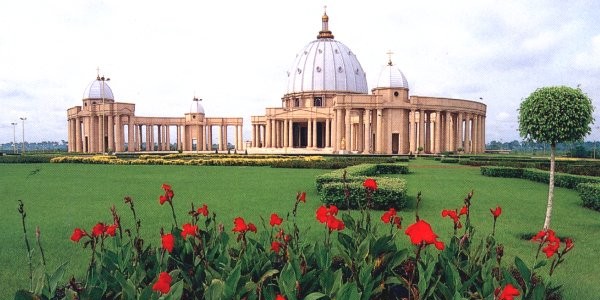
Largest Church in the World: Our Lady of Peace of Yamoussoukro


This is very bizarre. The largest church building in the world is in a fairly small city with a tiny Catholic population. But it looks like a fascinating place, so enjoy the pictures and some good info from The Epoch Times:

The world's largest Christian church has 7,000 individually air-conditioned seats, standing-room for 11,000 in a surrounding 3ha marble plaza, and enough room for 100,000 more – 300,000 at a squeeze – beyond that.

Yet the chances of even the 7,000 seats ever all being occupied at one time are about nil, because rather than finding this church in one of the great cities of the world, you'll discover it in a community of just 120,000 people in the middle of the jungled hills, arid plains and farmlands of Africa's Ivory Coast.

And poverty, for few homes away from this city's strange CBD have even the basics of running water and sanitation.

We're talking about Yamoussoukro, the Ivory Coast's capital, and it's unusual Roman Catholic Basilica of Our Lady of Peace.

Which is the more bizarre is a matter of conjecture. Twenty-odd years ago the country's then-President, Felix Houphouet-Boigny decided that the little village of Yamoussoukro, his birthplace, would become the country's new capital.

He enthusiastically set about the conversion, building with his own and taxpayer money, universities, hotels, an 18-hole golf course for visiting dignitaries, lush parklands, boarding schools, and eight-lane boulevards to link the lot.

Plus an airport that was the only one in Africa big enough to take the Concorde, a presidential palace with a lake stocked with scores of Sacred Caymans (crocodiles,) and the Basilica of Our Lady of Peace.

And while visitors today still land at that airport, can play 18-holes, stay and dine 5-star at the swank 15-storey Hotel President (naturally,) find themselves on boulevards to nowhere, and watch the afternoon feeding of the crocodiles at the palace, it's the Basilica they want to see.

(And amidst all else, they discover a scattering of government buildings, modern and traditional stores and businesses, and homes of the less well-off.)

Modelled largely along the lines of St Peter's in Rome that took 109 years to build, the Yamoussoukro Basilica cost USD$300m and took 1,500 largely-Ivorians just three years to construct.

President Houphouet-Boigny thought it only appropriate that Pope John Paul II officially consecrate the building, but when the Vatican learned that its African St Peter's look-alike was going to be higher than the original, it laid down two rules: one was that the dome of Yamoussoukro Basilica not be higher than St Peter's, and the other that a hospital for the poor be built near the new church.

The President concurred… but somehow, just somehow, the cross on his Basilica is 17m higher than that of St Peter's. [...]

Tuesday, April 08, 2008

Report on Sept. 6 strike to show Saddam transferred WMDs to Syria

Who knows if this is true, but if it is then it's big news:

Report on Sept. 6 strike to show Saddam transferred WMDs to Syria

An upcoming joint US-Israel report on the September 6 IAF strike on a Syrian facility will claim that former Iraqi president Saddam Hussein transferred weapons of mass destruction to the country, Channel 2 stated Monday.

Furthermore, according to a report leaked to the TV channel, Syria has arrested 10 intelligence officials following the assassination of Hizbullah terror chief Imad Mughniyeh.


[Jerusalem Post]

Christianity Today: Jordan evicts evangelicals

Country hailed for tolerance deports at least 27 Christians.

[...]

Jordan said through its U.S. embassy that the deportations came in response to complaints from Catholic and Orthodox bishops about evangelicals' proselytizing. Much of evangelicals' growth has come from the conversion of nominal Catholic and Orthodox believers.


However, one evangelical leader in Jordan said multiple factors, including new pastors with better training, increased access to satellite TV and the Internet, and prayer are combining to draw Jordanians to the Christian faith.


"I wish what the government accuses us of doing was true, that we are doing evangelism, giving Bibles away, going to the streets," he said. "But these people are just coming to us, and they have a hunger."


Jordan's moderate government is facing growing political pressure from at least three sources: Islamic fundamentalism, turmoil in surrounding nations, and the economic strain of hosting almost one million Iraqi refugees. Observers say reducing the number of foreign evangelicals allowed the government to build political capital with both Muslim hardliners and Christian bishops.


"Jordan has bigger problems than missionaries," said one longtime missionary in the country. "Jordan is more afraid of internal security threats than of religion."


Some of the deportations can also be attributed to well-intended Western missionaries with flawed practices. "Too much of the evangelical 'evangelism' in Jordan is spurred on by demands from sending agencies in America who require quick results and statistics that assure donors of success by American church-growth standards," said Leonard Rodgers, executive director of Evangelicals for Middle East Understanding.


Observers said missionaries to Jordan should devote more attention to interfaith and ecumenical discussions, and to strengthening indigenous Jordanian churches. [...]