In this empty hallway, there’s nothing expected of us at this moment. The work is out of our hands, and all we can do is wait, breathe, look around. People sometimes feel like this when they’ve been up all night with someone who’s seriously ill or dying, or when they’ve been through a non-stop series of enormously demanding tasks. A sort of peace, but more a sort of ‘limbo’, an in-between moment. For now, nothing more to do; tired, empty, slightly numbed, we rest for a bit, knowing that what matters is now happening somewhere else.
–Archbishop of Canterbury Rowan Williams
(HT to TitusOneNine)
Saturday, March 22, 2008

Saudis to retrain 40,000 clerics
Saudis to retrain 40,000 clerics
[...] Saudi clerics have long been accused of encouraging Saudi youth to join global jihad and of inciting hatred of non-Muslims.
Nearly 1,000 imams have already been sacked over the past few years.
The Saudi royal family has come under increasing pressure - mainly from Washington - to change religious textbooks and to rein in militant clerics.
But critics are sceptical about whether such initiatives would work as long as the powerful, and ultraconservative, religious establishment in Saudi Arabia continues to exert enormous influence over society.
Only last week, a prominent cleric called for the beheading of two liberal writers who had questioned the orthodox view that Muslims can not change their religion.
Good Friday, the Gospel of John, Fake Peace, and Real Peace
From Peter Leithart, who is brilliant:
...Rome brings final peace and justice to the world.
There was something to that, but in the trial of Jesus we discover the blunt injustice and bald pragmatism on which Roman peace was founded. Three times Pilate declares Jesus innocent: I find no fault in Him, I find no fault in Him, I find no fault in Him. But the Jews insist that since Jesus has made Himself a king, He threatens the Roman empire, and it’s clear from the agitation of the Jews that Jesus threatens the peace of Israel. If I don’t get rid of Jesus, Pilate reasons, I’m going to have no end of trouble from these Jews. I could lose support in Rome, and I could lose my job. It’s better for one innocent man to die than for me to be faced with enraged Jewish agitators. It’s better that one man die, than for me to lose the perks of being a provincial governor.
This is Roman peace. It is peace founded on the murder of the innocent. It’s a peace designed to protect the interests of those who hold power. It is peace from the barrel of a gun. Augustine recognized that Roman peace is a kind of peace; you can keep most people quiet if you have enough guns. But it is only a shadow of the tranquility of order that is true peace.
For their part, the Jewish leaders realize that Jesus threatens the nation – or, more precisely, their leadership of the nation. “One man must die for the people,” Caiphas said, thinking not of substitutionary atonement but of national survival. If Jesus isn’t stopped, he reasons, then the Roman army will come crashing down on us to destroy the temple and scatter our people.
In the event, we know this is ironic, because the New Testament shows that the Jews’ rejection of Jesus and the apostles is precisely what brings the Roman siege engines to Jerusalem. That irony is already evident in the trial itself. The Jews are given a choice of Jesus or Bar-abbas, Jesus or this other “Son of the Father.” They choose Bar-Abbas, and that choice expresses a political agenda. For Bar-Abbas is not a “robber” but a rebel leader, an insurrectionist, a bandit who uses his banditry to destabilize Rome. We could without much exaggeration call him a terrorist. This is the man the Jews want more than Jesus. This is the path they choose. To save themselves from the Rome, they choose a man who devoted his life to provoking Rome. [...]
The Harrowing of Hell
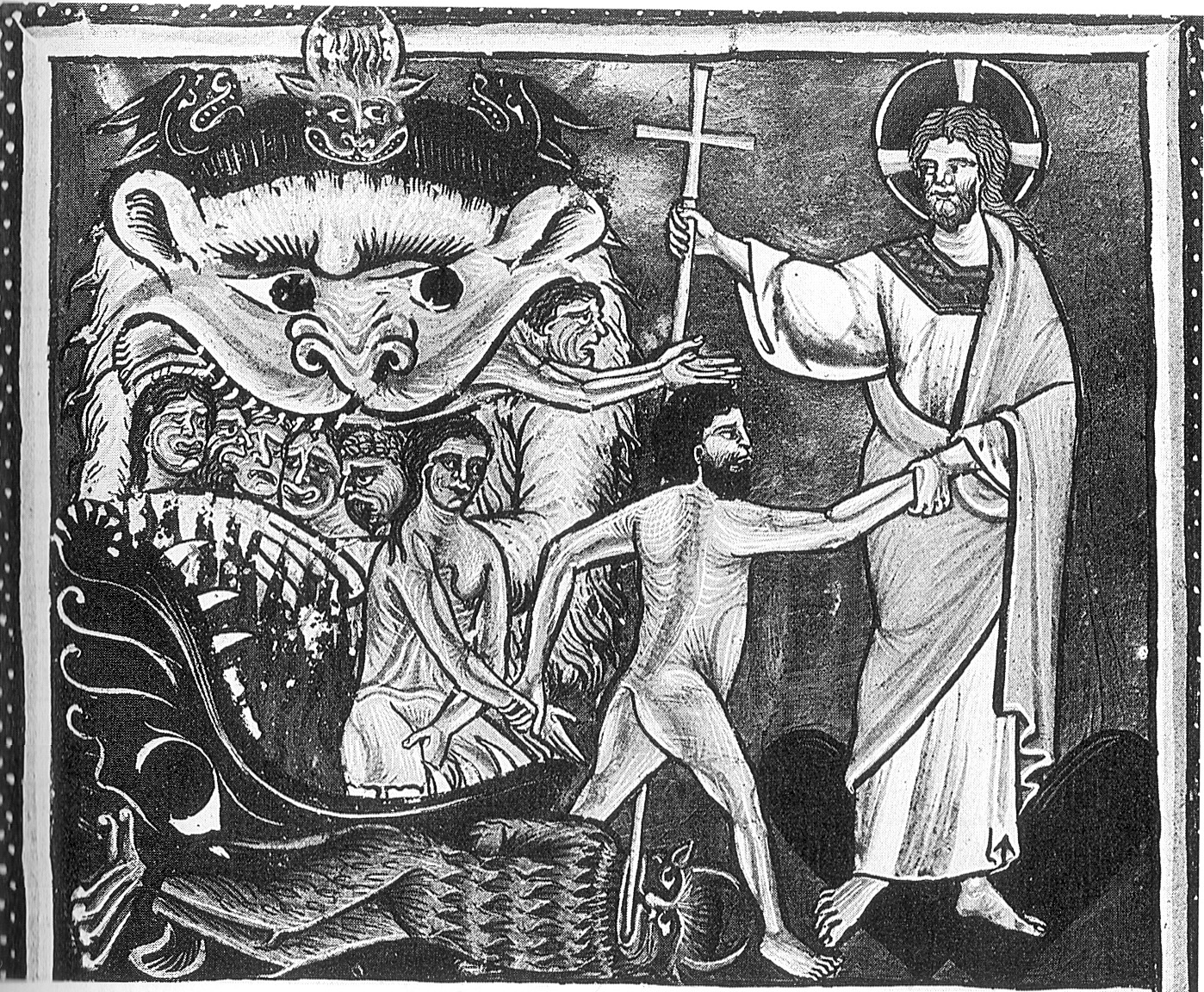
Holy Saturday: Christ descends to the grave and opens the gates for the righteous deceased.
Friday, March 21, 2008
Video from Sana'a in Yemen
Nate has posted some nice footage of Sana'a the capital city of Yemen at his blog. Check it out:
Pictures of Redemption
Liberal Christianity and Decline
One could find similar figures for the other large, liberal denominations (ELCA, PCUSA, UMC, etc.):
The raw, ugly truth is that there are less than 800,000 practicing Episcopalians on any given Sunday. That number is declining at the rate of 1,000 a week. According to a Pew Forum on Religion & Public Life survey, the Episcopal Church is the fastest dying mainline protestant denomination in America. It dropped 1.5% in attendance last year. That figure is projected to only increase and escalate in 2008.
The Episcopal Church has declined in absolute numbers. According to statistics presented by Kirk Hadaway, the Episcopal Church's director of research to the Executive Council, the church is losing 1,000 parishioners per week. Only one in three Episcopalians attends a parish church on a weekly basis. Membership in all 110 dioceses of the Episcopal Church totaled 2,320,506 in 2006, down 2.2%, or 51,502, from 2,372,008 in 2005. That's the equivalent of 1,000 Episcopalians walking away from the Episcopal Church each week. There is no indication it will turn around any time soon, if ever. Since 2007, the decline has only accelerated.
One entire diocese, - San Joaquin - taking about 90 percent of its members, has departed the Episcopal Church. Three more dioceses, - Ft. Worth, Quincy and Pittsburgh, will, in all likelihood, leave over the next year taking thousands more with them. In the past 10 years, over 10 of the largest Episcopal parishes in the country have fled to other jurisdictions, my rector tells me. What does that tell you?
The figures don't lie. The Episcopal Church is not growing, it is dying.
From HERE.
Muhammad not 'the founder of Islam'
Muhammad is Allah’s Last Messenger, not the ‘founder’ of Islam
BY SUMAYYAH MEEHAN (Living Islam)
21 March 2008
THE Prophet Muhammad’s (pbuh) name has yet again been in the media as of late due to the republication of the offense Danish cartoon caricatures that continue to be used to taunt Muslims and tarnish the good name of the final messenger (pbuh).
As I watched the recent protests unfold on live television from Muslims around the world in Afghanistan, Pakistan and other nations, I became increasingly irritated with the broadcaster’s commentary. She kept referring to the Prophet Muhammad (pbuh) as the ‘founder’ of Islam. And even her interviewees responded in a similar fashion by also referring to him as the ‘founder’ of Islam.
To imply that Muhammad (pbuh) founded Islam or created it is a gross and reprehensible lie that quite often is used by the enemies of Islam to water-down the impact that Muhammad’s (pbuh) prophethood had on the entire world. This world has never seen a greater man, prophet, father, statesman, politician, orator, warrior, commander, friend, teacher or confidant than Muhammad (pbuh).
The simple fact remains that centuries after Muhammad’s (pbuh) death, Islam runs strong with people converting every single day because the message of Allah in the Holy Quran rings true and is enticing to the seekers of all that is good in this world. The founder of Islam is actually Allah Almighty. Allah chose Muhammad (pbuh) to be the final Prophet sent to this world to give both a warning and glad tidings. [...]
Thursday, March 20, 2008
Erik Twist, Part X: No Loopholes
Part 10 of his Why Catholic? series:
[...] Fr. Scott’s way of approaching issues was, well, Magisterial. He spoke with clarity and confidence and in such a way that as I listened to him I was remembering why Catholicism had initially intrigued me; it had the audacity to speak as though it was authoritatively true. But most of all I was mesmerized by the philosophical consistency which under girded Fr. Scott’s responses. There were no loopholes. There was no jumping from one assumption to the next. There were reasonable answers for each reasonable question. In his responses I was constantly amazed by how they both upheld the dignity of mankind while not overshadowing the sovereignty of God. In Protestantism this never seemed quite possible. Either the former was emphasized to the point of secular humanism, or the latter was emphasized to the point of rigid Dutch Calvinism. [...]
Wednesday, March 19, 2008
Ziya Meral: Bearing the Silence
Excellent article here from a Muslim-background believer (MBB) in Turkey. Please do read it all, but here is one section:
Bearing the Silence
I must admit, I am no heavenly man! Unlike most other Muslim-background believers, there is nothing supernatural to tell about how I came in touch with Christians or decided to be one.
On the contrary, I went to an old Anglican church with some friends because of an article about it in a local Turkish newspaper, which accused it of luring young people to become Christians by offering them wine, 100 U.S. dollars every Sunday, and the possibility of marrying a young British woman.
I was 17 years old when I had to face my family and relatives about my decision to be a follower of Jesus. I remember vividly how fearful I was, and how isolated and alone I felt as I lay in the fetal position in a sleeping bag on a friend's floor.
I am still broke, sober, and single after all these years, and I still struggle with shame, loneliness, and fear.
[...] More Christians are killed than are saved from execution at the last minute. More Christians stay locked in prison, beaten and tortured, than are able to walk free, guided by miraculous escape plans. More Christians suffer lifelong deprivation of their most basic civic and economic rights. More converts from Islam give up their faith than stay Christians, and those who remain in the church struggle with lifelong battles with shame, depression, and isolation, caused by the loss of ties to their families, communities, and nations.
Above all, for the average persecuted Christian, there are unanswered prayers and the absence of peace, strength, courage, and joy. Their humanness in a very earthly plot line finds no place in our modern-day obsession with heroic stories with victorious resolutions. [...]
A Church in Saudi Arabia?
Very unlikely, IMHO. But still worth reading. Maybe in one of the special economic zones where regular Saudis are not allowed in without special permission...
A Church in Saudi Arabia?
Presiding over the cradle of Islam and home to its holiest sites, the Saudi monarchy has long banned the open worship of other faiths, even as the number of Catholics resident in Saudi Arabia has risen to 800,000 thanks to an influx of immigrant workers from places like the Philippines and India. Mosques are the only houses of prayer in a country where the strict Wahhabi version of Sunni Islam dominates. But Archbishop Paul-Mounged El-Hachem, the papal envoy to the smaller countries on the Arabian peninsula, such as Kuwait and Qatar, has confirmed that talks are under way to establish formal diplomatic relations between the Vatican and Saudi Arabia, and to eventually allow for Catholic churches to be built there. Pope Benedict XVI is believed to have personally appealed to King Abdullah on the topic during the Saudi monarch's first ever visit to the Vatican last November.
Top Vatican spokesman Father Federico Lombardi said that a Catholic parish in this key Islamic country would be "a historic achievement" in the push to expand religious freedom and foster a positive interfaith rapport. [...]
Most Palestinians favor violence over talks, poll shows
Most Palestinians favor violence over talks, poll shows
RAMALLAH, West Bank: A new poll shows that an overwhelming majority of Palestinians support the attack this month on a Jewish seminary in Jerusalem that killed eight young men, most of them teenagers, an indication of the alarming level of Israeli-Palestinian tension in recent weeks.
The survey also shows unprecedented support for the firing of rockets on Israeli towns from the Gaza Strip and for the end of the peace negotiations between Palestinian and Israeli leaders.
The pollster who conducted the survey, Khalil Shikaki, said he was shocked because it showed greater support for violence than any of the surveys he had conducted over the past 15 years in the Palestinian areas. Never before, he said, had a majority favored an end to negotiations or the firing of rockets at Israel.
[...]
His explanation for the shift, one widely reflected in the Palestinian media, is that recent actions by Israel, especially a series of attacks on Gaza that killed nearly 130 people, an undercover operation in Bethlehem that killed four militants, and the announced expansion of several West Bank settlements, has led to despair and rage among average Palestinians who thirst for revenge. [...]
VOM: Christians killed in Ethiopia
Christians Killed - VOM Sources/International Christian Concern
On March 3, Muslim militants killed at least two Christians and wounded dozens in Nensabo town southeast of Addis Ababa, Ethiopia. According to The Voice of the Martyrs contacts and reports from International Christian Concern, militants attacked Christians, including women and children, while they were attending a worship service. According to reports, "Eight of the wounded have been taken to the town of Awassa for hospitalization, while others with serious injuries were taken to Black Lion Hospital in Addis Ababa. Among the wounded were a police officer and a Christian whose hand was cut off by the attackers." Reports indicated that the attack was part of a plan by Muslim militants, influenced by the spread of Wahhabism, in the area to wipe out Christians from the Muslim-dominated region. Pray for those mourning deceased believers. Ask God to comfort them. Pray God will protect and guide believers in Ethiopia facing harsh conditions.
From persecution.com
Subscribe to:
Posts (Atom)